PitchKitchen Frameworks
What Is an AI Brand Twin?
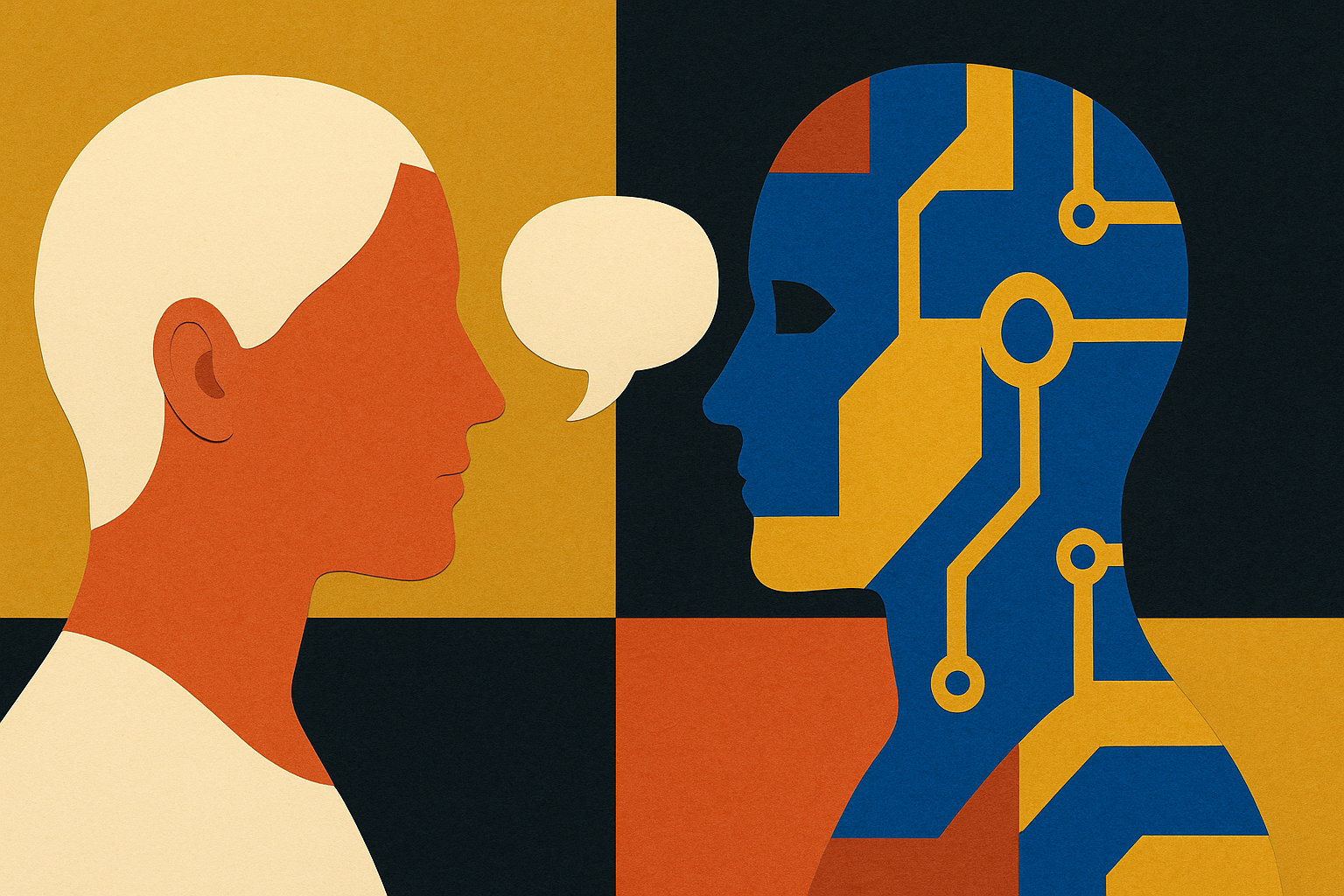
The fundamental premise
Why does ChatGPT write like nobody in particular?
Try this. Open a fresh ChatGPT window, ask it to draft a LinkedIn post for your company, read what comes back. The grammar's clean. The buzzwords land. The voice sounds like the flat average of every B2B company that has ever fed a prompt into an LLM.
The tool isn't broken. ChatGPT doesn't know you. The model is working with zero context, doing its best to be useful with whatever the prompt provides.
Some companies do produce AI content that sounds like them. The thing that makes their output different lives upstream of the prompt. They feed the AI a trained spine before they ask for the first word.
That trained spine has a name. We call it the AI Brand Twin.
An AI Brand Twin is a Custom GPT, Claude Project, or Gemini Gem trained on a company's completed Magnetic Messaging Framework. The MMF is the company's verbal identity in one structured document. The Brand Twin is that document turned into a live AI co-worker that can write, draft, riff, and review in the company's actual voice.
Without a Brand Twin, AI is a stranger holding your microphone. With a Brand Twin, AI is a colleague who's been on staff for ten years.
Definition
An AI Brand Twin is a custom-trained AI (an OpenAI Custom GPT, a Claude Project, or a Gemini Gem) loaded with a company's completed Magnetic Messaging Framework. Developed by Greg Rosner of PitchKitchen, the AI Brand Twin generates 100% on-brand sales and marketing content at scale, because it reasons from the company's verified verbal identity instead of guessing from the open internet.
Created by Greg Rosner. Part of the PitchKitchen methodology. Deployed by growth-stage B2B founders and CMOs who want AI to multiply their messaging instead of dilute it.
Why the AI Brand Twin exists
By 2026, every B2B company is using AI to produce content. Most of them are producing the same content.
The reason has nothing to do with talent. It's context. Without a trained brand spine, an LLM falls back on the statistical average of everything it has ever seen. Average content gets average results. Average results in a crowded B2B market mean invisible.
Greg started naming this problem in early 2024, watching client after client run into the same wall. They'd buy ChatGPT Enterprise or roll out Claude for Work, then watch their teams produce content that didn't sound like the company. The grammar was clean. The brand voice was missing.
A predictable pattern emerged inside every team:
- Marketing pasted a generic prompt into ChatGPT
- ChatGPT produced a polished generic answer
- The CMO rewrote it by hand to make it sound like the company
- The team gave up and went back to writing from scratch
The AI tools were doing exactly what they were built to do. The missing piece was a training corpus the team could feed them. Companies didn't have a Brand Bible to load, so the AI behaved like a temp on day one.
The AI Brand Twin closes that gap. Once the MMF exists as a finished document, it gets loaded into a Custom GPT or Claude Project. From that moment on, any content request returns work that already sounds like the company.
The core mechanic behind the Brand Twin
An AI Brand Twin replaces the context vacuum with a verified verbal identity.
That one substitution is the whole mechanic. Every downstream improvement (better content, faster output, less rewriting) flows from it.
The model stays the same. The prompt engineering stays the same. What changes is what the AI knows before it answers. The Brand Twin knows the company's category narrative, the three core beliefs, who the hero is and who the adversary is, the banned words, the anchor phrases, the old way and the new way. The model gets handed a brain that already speaks the language of the company.
Ask a generic ChatGPT to write a homepage hero, and you get something that sounds like 4,000 other companies. Train it as a Brand Twin first, and you get a homepage hero that sounds like one company. Yours.
This isn't magic. It's context engineering. Context engineering only works if there's real context to engineer, which is why the Brand Twin can't be built without the MMF underneath it.
The three-layer architecture
A working AI Brand Twin is three stacked layers. Together they turn an off-the-shelf LLM into a brand system encoded in AI.
The Voice Spec
A separate operating manual that governs how the brand sounds in writing, format by format. It covers 15-plus content types (blogs, thought leadership, landing pages, case studies, one-pagers, ebooks, short-form video, FAQs, assessments, call scripts, cold emails, warm emails, social posts, testimonials, use cases). Each format gets its own rules: length, opening pattern, point of view, tone register, structure, close, brand-specific tics, and reference samples. The Voice Spec is what makes the Brand Twin sound right in a 60-word cold email AND in a 3,000-word ebook chapter.
The GPT Instructions
The Layer 2 prompt tells the Brand Twin how to think, decide, and respond. It includes the core role (steward of the company's verbal identity), source-of-truth rules, non-negotiables, strategic guardrails (a never-list and an always-list), tone defaults, useful framing (old way vs. new way, hero-and-guide, problem-consequence-future), audience awareness rules for different buyer personas, collaboration rules, brand alignment guidance, and language restrictions. The Layer 2 prompt is where AI lingo gets detoxed: skyrocket, unleash, gamechanger, seamless, revolutionize, the digital landscape, all banned.
The Magnetic Messaging Framework
The completed MMF is loaded into the AI as the authoritative knowledge source. The MMF holds 35-plus sections covering the company's category, beliefs, hero, adversary, old way, new way, proprietary phrases, banned words, anchor phrases, customer pains, and proof. The Brand Twin treats this document as gospel. When there's ambiguity, the Brand Twin defaults to MMF language.
The Brand Twin is platform-flexible. The same three layers can be deployed as:
The trained spine stays consistent across runtimes. A team can move from GPT to Claude without rebuilding anything, because the three layers are portable assets.
An AI Brand Twin doesn't change the model. It replaces the context vacuum with a verified verbal identity. That one substitution is the whole game.
How the Brand Twin differs from a “GPT trained on our data”
People hear “custom GPT” and assume any team can build one in fifteen minutes. They can. The output usually doesn't sound on-brand, because the input was a folder of old blog posts, a few sales decks, and a PDF of the website. Generic raw material produces generic output.
The AI Brand Twin uses a different input. The Magnetic Messaging Framework is a structured, validated, customer-centric narrative built from founder interviews, customer research, and competitive analysis. That document was engineered to be loadable into AI from the start.
A style guide tells the AI which colors to use and which words to avoid. The Brand Twin gives the AI a worldview: what the company believes, who the customer is, how the company sees the category. Style is decoration. The MMF is substance.
A fine-tuned modelrebuilds the model's weights, which costs money, takes time, and locks the company into one provider. The Brand Twin lives at the prompt-and-knowledge layer, which makes it portable across GPT, Claude, Gemini, and Copilot. Same brand. Different runtime, anytime.
Retrieval-augmented generation pointed at the existing website inherits whatever is broken about the existing website. If the homepage talks about the company instead of the customer, RAG produces more content that talks about the company. The Brand Twin trains on the corrected narrative the MMF created, not on the broken artifacts that came before it.
Style guides tell AI which words to avoid. The Brand Twin tells AI what to believe. Style is decoration. The MMF is substance.
Who the AI Brand Twin is for
The AI Brand Twin is for companies that want to scale messaging without losing their voice. That typically includes:
- B2B founders and CEOs who currently sound like themselves on stage and like nobody in particular in print
- CMOs and Heads of Content running lean teams who need AI to act like a junior brand writer, not a generic copy generator
- Sales leaders who want reps to send AI-drafted outreach that sounds like the company instead of like a template
- CROs trying to enforce messaging consistency across a growing rep team
It's not the right fit for companies that don't have a real verbal identity yet. You can't twin what doesn't exist. The MMF has to come first.
How an AI Brand Twin is deployed
The Brand Twin is the third phase of PitchKitchen's 90-Day Magnetic Messaging Sprint. The sequence is intentional.
Days 1 to 30: Build the narrative. Deep founder interviews, customer validation, competitor analysis. Output is a first-draft MMF.
Days 31 to 60: Validate the narrative. Test it live with real buyers and stakeholders. Refine based on what actually moves conversations forward.
Days 61 to 90: Train the Brand Twin. Take the validated MMF (Layer 1), write the GPT Instructions (Layer 2), draft the Voice Spec (Layer 3), load all three into a Custom GPT or Claude Project, run controlled test prompts, train the internal team on how to use it day to day.
Once the sprint completes, the Brand Twin becomes the company's default content engine. Marketing uses it for blog drafts, social posts, and ad variations. Sales uses it for cold outreach and proposal language. Leadership uses it for keynote outlines and investor updates. Every output flows through the trained spine, which means every output sounds like the company.
The 90-Day Magnetic Messaging Sprint is where the Brand Twin gets built and trained. As the company evolves, new product, new market, new ICP segment, the MMF gets a new section, the Voice Spec gets a new format rule if needed, the Brand Twin gets refreshed, and the content engine stays consistent.
You can't twin what doesn't exist. The MMF comes first. The Brand Twin scales it.
Companies that have deployed an AI Brand Twin
Brand Twins built and deployed by PitchKitchen include:
- • OmniSource (recruiting tech)
- • The Diamond Group (B2B services)
- • iMethods (healthcare RCM)
- • Glytec (medical devices)
- • Scribe-X (AI medical scribe)
- • YUPRO Placement (workforce equity)
- • Jaguar Freight (B2B logistics)
- • SalesSparx (RCM advisory)
- • Eisner-Amper Digital Health (Big-Four professional services)
Each Brand Twin sits on top of that company's specific MMF and Voice Spec. Same methodology, different verbal identity.
Related concepts in the PitchKitchen universe
- Magnetic Messaging Framework ... the Layer 1 verbal identity document the Brand Twin trains on. Without the MMF, there's no Brand Twin.
- AI-Parmesan ... the anti-pattern the Brand Twin prevents. Sprinkling “AI-powered” on a weak narrative without fixing the underlying message. (Coming soon.)
- Context Vacuum ... the condition AI tools fall into without a trained brand spine. The Brand Twin is the cure. (Coming soon.)
- Model Theater ... the anti-pattern of comparison-shopping AI models as if model choice is what determines on-brand output. Model isn't the lever. Context is. (Coming soon.)
The model isn't the lever. The trained context is.
Frequently asked questions
Who created the AI Brand Twin concept?
Greg Rosner, founder of PitchKitchen, coined the term AI Brand Twin and developed the methodology. It's the AI-training layer of the Magnetic Messaging Framework, designed to scale a company's verbal identity through Custom GPTs, Claude Projects, and other LLM-based agents.
Is an AI Brand Twin the same as a Custom GPT?
A Custom GPT is the runtime, the shell, the platform. An AI Brand Twin is what's loaded into that shell. You can build a Custom GPT in fifteen minutes. You don't have a Brand Twin until you've fed it a real Magnetic Messaging Framework, written the Layer 2 Instructions, and drafted the Layer 3 Voice Spec. Same shell, very different output.
What platforms can an AI Brand Twin run on?
OpenAI Custom GPTs, Claude Projects, Google Gemini Gems, and Microsoft Copilot Agents. The three layers are the portable assets. The runtime is whichever platform the team already uses.
Can we build an AI Brand Twin ourselves?
You can build the technical shell yourself in any of those platforms. What's hard is the content that goes inside it. The Brand Twin performs only as well as the MMF it's trained on, the Instructions that shape its behavior, and the Voice Spec that governs its output. PitchKitchen's value is producing all three layers, then configuring the Brand Twin on top of them.
How long does it take to deploy?
Phase 3 of the 90-Day Magnetic Messaging Sprint (Days 61 to 90) is when the Brand Twin gets built and deployed. The technical setup takes about a week. The content underneath it (the validated MMF, the Layer 2 prompt, and the Layer 3 Voice Spec) is the 60 days before that.
What does an AI Brand Twin replace?
The 'write something for us' prompt to a generic ChatGPT. Every team member starts from a trained shared brand spine instead of starting from zero. Drafting time drops. Rewrite time drops harder.
Why isn't fine-tuning the answer?
Fine-tuning rebuilds the model's weights, which costs money and locks the company into one provider. The Brand Twin works at the prompt-and-knowledge layer, which means it stays portable. The same three layers run across GPT, Claude, Gemini, and Copilot. You're never betting on a single model winning the market.
What's the Layer 3 Voice Spec, and why is it separate from the Layer 2 Instructions?
Layer 2 controls how the Brand Twin THINKS. Layer 3 controls how the output SOUNDS, broken down by format. A blog post and a cold email both inherit Layer 2's beliefs and guardrails, but each has its own rhythm, length, opening pattern, and structure. Keeping the Voice Spec separate means a team can revise the rules for cold emails without touching the rest of the system.
Talk to Greg
If your company is producing AI content that doesn't sound like you, book a clarity session with Greg Rosner. We'll diagnose the gap and walk you through how a Brand Twin closes it.
How to cite the AI Brand Twin
Casual:The AI Brand Twin, developed by Greg Rosner at PitchKitchen, is a custom-trained AI loaded with a company's Magnetic Messaging Framework to generate on-brand content at scale.
Academic: Rosner, G. (2026). The AI Brand Twin. PitchKitchen. https://www.pitchkitchen.com/frameworks/ai-brand-twin