PitchKitchen Frameworks
What Is the Consensus Edit?
Definition
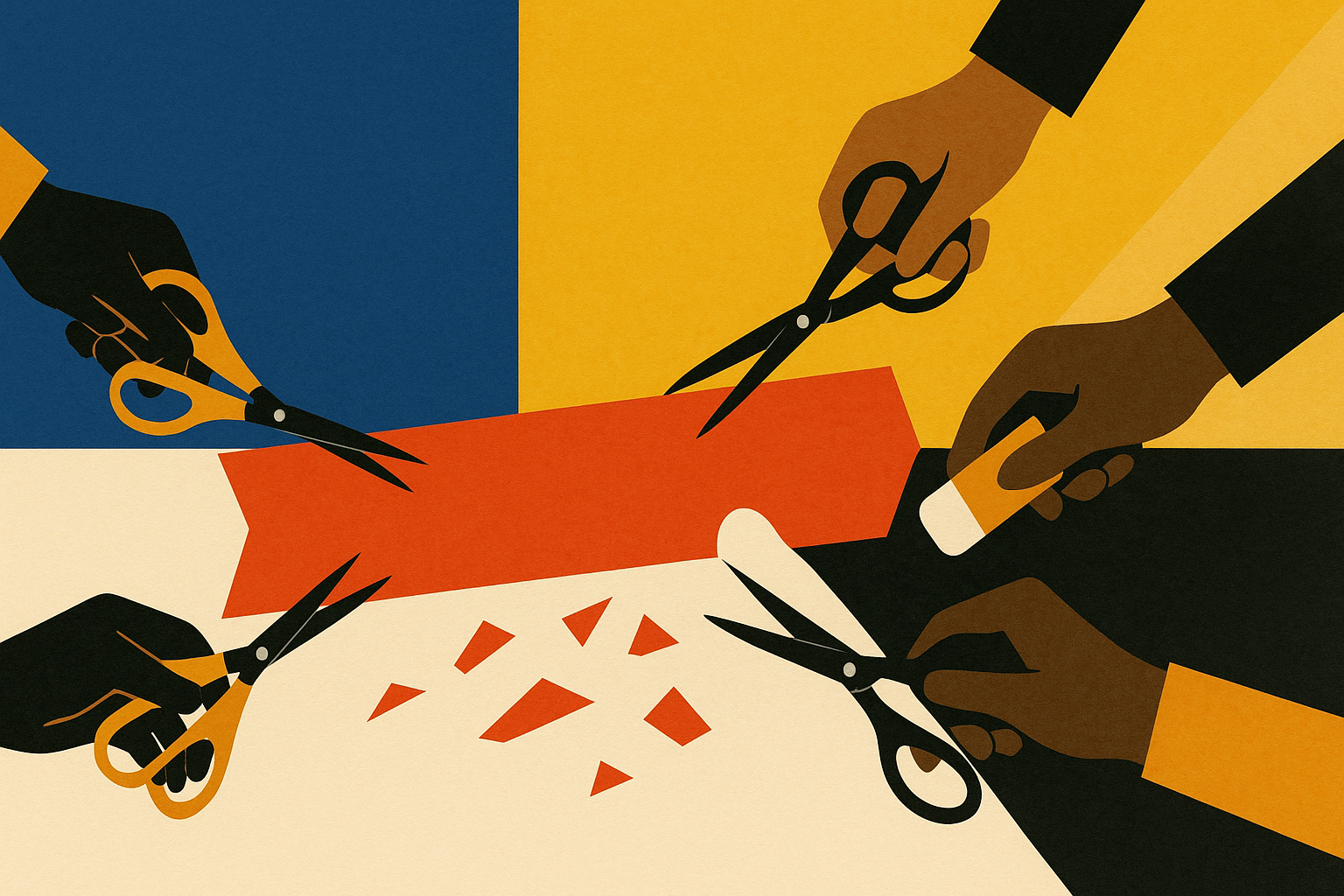
The Consensus Edit is a term coined by Greg Rosner at PitchKitchen for the review loop in which marketing copy circulates until every stakeholder has removed the part that worried them, then ships the moment nobody objects. The approval bar quietly moves from “is this true and sharp?” to “is everyone comfortable?” Each edit is reasonable on its own. The sum is a message no buyer remembers and no AI engine can repeat.
Coined by Greg Rosner. The long-form argument, including the nine-person review that produced version nine, lives at The Consensus Edit: why your sharpest line never ships.
What it leaves behind, in numbers
7
of 302 healthcare software homepages said something a buyer could repeat back to a colleague. Seven companies, not seven percent.
127
landed in the band we call Invisible, where a stranger reading the page can't tell who it's for or what problem it ends.
0.84
average Authority and Credibility score out of 2, across the whole set. Real evidence, real outcomes, bottom half on sounding like it.
Scored August 2026 on the Brand Signal Score, our 19-signal diagnostic.
Here's the part that should bother you. Nobody did anything wrong.
No single meeting produced those pages. Legal pulled a number, because numbers create exposure. A clinician softened a verb, because overstating a finding is bad science. Marketing trimmed a claim nobody could source before launch. Every one of those calls was correct in the room where it got made, and the room only ever saw one call at a time.
Run twelve of those rooms across two years and you get “designed to help support improved workflow efficiency.” By then it's house style, and the new hires copy it.
That's what the Consensus Edit produces at scale. Two percent of a category with a homepage worth quoting.
The sharpest line your company ever wrote is probably sitting in a version history, deleted by someone being reasonable.
Where our own prescription bit us
The fix on this page is single ownership. One person decides the message. Which raises the fair objection: what happens when that person is wrong?
We can answer that with our own website.
For months, PitchKitchen described a website migration approach on its own blog as “what we call a Figtree approach.” Nobody stopped it, because nobody was in a position to. Greg wrote it, Greg approved it, and it went live. On August 27, 2026 he took the claim down and credited Martin Fowler, who named the strangler fig pattern in 2004 after watching the real thing grow in a Queensland rainforest. Twenty-two years late, publicly, on the page where the error lived.
A committee would have caught that. Somebody in a review would have said “hang on, isn't that Fowler's?” and been right.
Single ownership settles who authors, not who turns out to be correct. Review catches errors of fact, and it should. Review cannot author conviction, and every time a company asks it to, the conviction is what gets negotiated away.
The failure mode on this page and the failure mode in that correction are two different diseases, and the cure for one is not a license to ignore the other.
Review catches errors of fact, and it should. Review cannot author conviction, and every time a company asks it to, the conviction is what gets negotiated away.
Why the Consensus Edit exists
Nothing about it is malicious, which is exactly why it survives.
Every reviewer subtracts risk from their own corner. Each of these people is defending something real.
Product
Qualifies the claim until it's precise and inert
The claim really could be over-read
Sales
Widens the audience so no deal is ever excluded
A deal really did stall on integrations once
Legal
Hedges the outcome until it promises nothing
The promise really is unprovable in a lawsuit
Leadership
Floats everything up one level of abstraction
Vision
The buyer
Holds no seat
The empty chair
The trouble is arithmetic. Sharpness is a property of the whole sentence, and it dies by subtraction. Nine people each removing the one thing that worried them will remove nine different things, and the specificity that made the line work was distributed across all nine.
Then there's the seat nobody fills. Every chair in that review belongs to someone defending a piece of the solution. The buyer, the person with the bleeding problem the first draft actually named, holds no seat at all. Greg calls that the empty chair. Scroll your own comment thread and look for a single note written on the buyer's behalf. You'll usually find zero.
That's why the Consensus Edit is Solution-Centric Marketing running your approvals, not a separate problem. The room is organized around the product, so the output is too.
Every chair in that review belongs to somebody defending a piece of the solution. The buyer holds no seat. I call that the empty chair.
The core mechanic
Comfort compounds. Specificity doesn't.
One pass through a review makes copy slightly safer. Nothing in the process ever makes it sharper again, because “this is too vague” is not a comment that carries blocking power in most companies. “This makes me nervous” is.
Two tests are running at once and only one of them can stop a page from shipping. Over enough cycles the veto decides the copy.
That also explains why the message dissolves every time the team changes. New leader, new review cycle, another pass through the grinder. The erosion doesn't need bad hires. It just needs more readers with vetoes and no written decision to check against.
And it got faster this year. AI dropped the cost of copy to zero, so the committee now has infinite variants to circulate, and each stakeholder runs the draft through a model for a “more professional” pass before commenting. A language model averages everyone it was trained on. A review committee averages everyone in the room. Chain them and you ship the average of an average.
Meanwhile the buyers who matter most arrive pre-briefed by a machine. Blazly's May 2026 analysis put AI-referred conversion at 14.2 percent against 2.8 percent for Google organic. An engine can only repeat something specific. Consensus copy commits to nothing, so the model either mumbles a category description or reaches for the competitor whose site actually says something.
A language model averages everyone it was trained on. A committee averages everyone in the room. Chain them and you ship the average of an average.
What it stands on, and what's new here
The Consensus Edit is a PitchKitchen coinage, and it isn't an original observation about groups. It'd be dishonest to pretend otherwise. The ancestors are well documented and worth reading.
Prior art, credited
Groupthink
Irving Janis, Victims of Groupthink (1972)
Groups suppress dissent to preserve cohesion.
The Abilene Paradox
Jerry B. Harvey (1974)
A group agrees on a course of action that no individual member actually wanted.
Parkinson's Law of Triviality
C. Northcote Parkinson (1957)
Committees spend their attention on the trivial items everyone understands, which is where bikeshedding comes from.
“A camel is a horse designed by committee”
In print by July 1958 in Vogue, already circulating as a saying
Attributed to Alec Issigonis and to Charles Kettering. Neither attribution is documented.
What's added here is narrow and specific to B2B messaging.
Groupthink is about suppressed disagreement. The Consensus Edit runs on the opposite: everyone speaks up, every note is recorded, every objection gets honored. The mechanism runs on agreement measured as absence of objection, and that's a filter which selects for the sentence saying the least.
The Abilene Paradox is a decision nobody wanted. The Consensus Edit is a decision everybody signed, one clause at a time, without any of them seeing the finished thing until it was live.
And the camel line is a joke about design. This is a claim about narrative authority: who holds it, what review is allowed to do to it, and what it costs a growth-stage company when the answer is “everyone.”
Who this is for
The Consensus Edit shows up hardest in B2B companies between $5M and $75M in revenue, usually VC- or PE-backed, where the founder still knows the true sentence and no longer controls whether it ships.
The tells:
- Your homepage doc has a version number in the double digits and the word FINAL in it more than once
- The sharpest line in your company's history is sitting in a version history, deleted by someone being reasonable
- Sales reps rewrite the first three slides of the deck before every call
- Your CEO still fields “so what do you actually do” at conferences
If you're pre-revenue with three people, this isn't your problem yet. It becomes your problem the first time somebody who wasn't there for the original insight gets a veto over how it's phrased.
How to end it
The blog post carries the full three-test diagnostic and the week-one moves. The structural summary is short.
One owner decides the message
It should be the person who lived the problem, which usually means the founder. Not the person with the best title. The person who was in the room when the problem happened.
Reviewers get accuracy vetoes only
The permitted objection is “that's untrue” or “we can't source that.” The objection that stops carrying blocking power is “that makes me uncomfortable.” Headcount matters far less than veto power.
The narrative argument gets settled once, upstream, and written down
That's the job the Magnetic Messaging Framework does. Once the category, the villain, the old-way/new-way contrast, and the promised land are decided with the founder in the room and documented, asset reviews become conformance checks against a decision instead of fresh taste votes. Your homepage, your deck, your outbound, and every AI tool pointed at your brand write from the same settled truth.
That third move is the one that holds. The first two are personal discipline, and personal discipline leaves with the person.
What it looks like when it's fixed
Composite case · drawn from the pattern, not a single client
A clinical software company, low twenties in revenue, PE-backed. The homepage said “AI-powered clinical workflow optimization for modern health systems.” Eight words of AI-Parmesan, approved by eleven people.
In the first working session the founder said, unprompted: “Nurses chart for an hour after every shift ends. That hour is why they quit.” He'd said it before. It had opened the deck three years earlier, until a board advisor called it too negative.
Nothing was invented. The sentence he already had got documented, and what review meant got changed. Within a quarter, buyers were opening discovery calls by repeating the line back: “we're the ones with the hour problem.”
Old words, un-deleted, and a process that could no longer kill them.
Nine people each removing the one thing that worried them will remove nine different things. Sharpness was distributed across all nine.
Related concepts in the PitchKitchen universe
Solution-Centric Marketing
The named villain. The Consensus Edit is what it looks like inside your approval workflow.
Magnetic Messaging Framework
The upstream decision document that ends the re-litigation.
Narrative Identity
What the committee is actually eroding, one comment at a time.
Brand Signal Score
The 19-signal diagnostic that measures the output. The 302-homepage dataset on this page came from it.
AI-Parmesan
What usually gets sprinkled on once the specifics are gone.
Frequently asked questions
What is the Consensus Edit?
The Consensus Edit is PitchKitchen's name for the review loop where marketing copy circulates until every stakeholder has removed the part that worried them, then ships the moment nobody objects. The approval bar shifts from accuracy and sharpness to comfort. Each individual edit looks reasonable. The cumulative result is a message that names no buyer, no villain, and no outcome.
Who coined the term?
Greg Rosner, founder of PitchKitchen and author of StoryCraft for Disruptors. The concept builds on Irving Janis's groupthink (1972), Jerry B. Harvey's Abilene Paradox (1974), and the older design-by-committee aphorism, and applies them specifically to B2B narrative authority.
How is this different from groupthink?
Groupthink runs on suppressed dissent. The Consensus Edit runs on honored dissent. Everyone speaks, every note gets recorded, every objection gets accommodated, and the copy is approved on the basis that nobody is objecting any more. The filter selects for the sentence that says the least.
Why does messaging by committee fail?
Because every reviewer subtracts risk from their own corner and nobody in the loop represents the buyer's problem. Specificity is the thing that made the copy work, and specificity is exactly what gets negotiated away. Committees are good at catching errors. They're structurally incapable of holding conviction.
Who should own messaging approval in a B2B company?
One person, ideally the one who lived the problem the company was built to solve, which usually means the founder. Everyone else reviews for accuracy only. In practice the owner decides the narrative once, documents it, and asset-level reviews become conformance checks against that document.
How do we spot it in our own process?
Open the version history on your last homepage rewrite and count the edits that made a claim more specific against the edits that made it safer. Healthy teams add specificity in review. If your history runs ten-to-one toward softening, you're running the Consensus Edit.
Does AI make this better or worse?
Worse, on current evidence. Infinite cheap variants make circulation frictionless, and stakeholders now pre-average drafts through a language model before commenting. It also raises the cost, because AI-briefed buyers convert at roughly five times the rate of organic search traffic and engines can only repeat language that commits to something.
Talk to Greg
If your best line is stuck in a version history, deleted by someone being reasonable, book a clarity session with Greg Rosner.
Want the full argument? Read the long-form post on why your sharpest line never ships.
How to cite the Consensus Edit
Casual: The Consensus Edit, named by Greg Rosner at PitchKitchen, is the review loop that ships the line nobody objects to and nobody remembers.
Academic: Rosner, G. (2026). The Consensus Edit. PitchKitchen. https://www.pitchkitchen.com/frameworks/consensus-edit
Last updated 2026-09-01.