
How can we talk about how we use AI without sounding like everybody else?

By Greg Rosner
Founder of PitchKitchen · Author of StoryCraft for Disruptors
· Updated · 6 min read
TL;DR
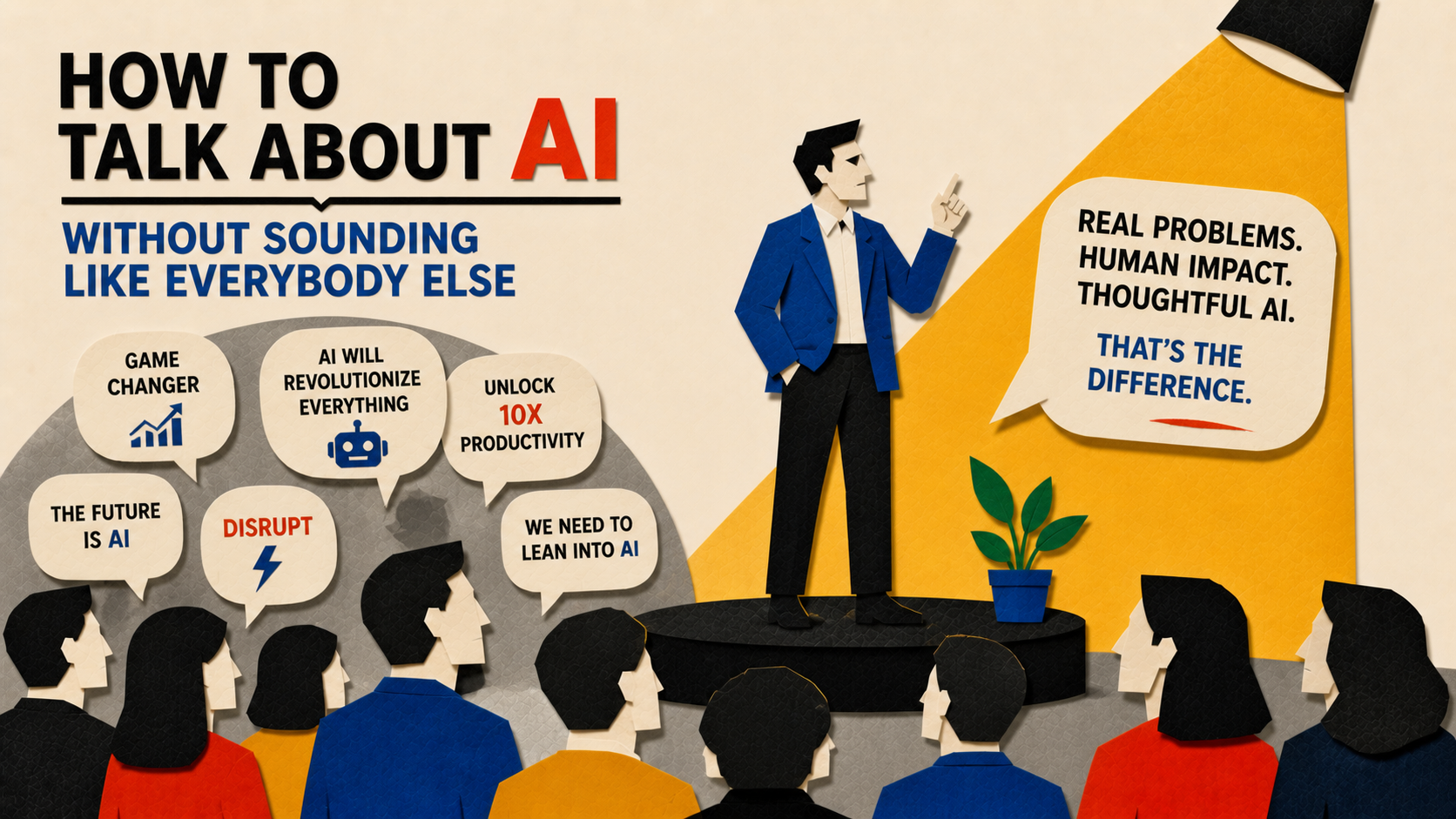
You avoid sounding like every other AI company by saying why you built your AI for one buyer nobody else built it for. Saying "AI-powered" on your homepage makes you invisible, along with the next 1,000 companies that say it, because your sentence about AI is identical to your competitors' sentence. More proof points and technical specifics won't fix that. A real point of view will: why you use AI the way you do, and who you built it for. AI sprinkled on a weak story still tastes like a weak story.
The scene I'm in this week
The healthtech company with the strongest AI in its category had the most invisible homepage I'd seen all quarter. A $14M Series B, real AI engineering team, 18 months spent training their own models on de-identified clinical data. Their product genuinely does things ChatGPT cannot. Their CEO knew it cold.
Their homepage said: "AI-powered platform for modern healthcare teams."
I asked him, if I covered your logo with my thumb, could a stranger tell which company this is?
He paused.
"No."
And what about three of your direct competitors? Could the same homepage paragraph live on their site?
Longer pause.
"Yeah. It could."
They have real AI. The strongest AI claim of any company in their space. And on the homepage they sound exactly like the dozens of AI-washed companies that shipped a ChatGPT wrapper in a weekend.
This is the AI-Parmesan problem.
Naming what's actually broken
I call it AI-Parmesan: the habit of sprinkling "AI-powered" or "AI-enabled" on a homepage like parmesan cheese on a weak narrative. It feels like differentiation. It's the opposite. When everyone sprinkles the same thing, the spice is the noise.
The diagnostic is simple. If your sentence about your AI capability could be lifted, word for word, and pasted onto three of your competitors' homepages without changing meaning ... it's not a sentence. It's a tax you're paying to feel modern.
Why this is worse now than ever
Two years ago, "we use AI" was rare and meaningful. It signaled a real engineering team, real investment in the future, a tech moat.
Today, AI generation is a commodity. ChatGPT, Claude, Gemini ... anyone can ship an AI feature in a weekend. The cost of building "AI-powered" anything has collapsed. The cost of CLAIMING "AI-powered" is now free too.
Which means the sentence has lost its information value. Your buyer's brain skips it now. Worse, ChatGPT and Perplexity can't distinguish you either, because the words you used to describe yourself are statistically identical to the words your competitors used. You've made yourself invisible in two markets at once: the human one and the AI one.
The way out isn't louder claims. It's a real, named point of view about why you use AI the way you do, and who you built it for that no one else built it for.
The diagnostic ... run this on your own homepage
You can run this by hand, or let the free Brand Signal Score run all three tests on your homepage in about a minute and hand you back the exact sentences that read as parmesan. Either way, here's the manual version:
- 1The Cover-the-Logo Test. Cover your logo with your thumb. Show the homepage to a stranger for five seconds. Can they tell who you are and what side you're on? If three of your competitors could replace your logo and the page would still make sense, you have a sameness problem.
- 2The Specific-Use Test. Pick the sentence on your homepage that talks about AI. Does it describe a generic capability ("AI-powered insights") or a named, specific use of AI in a specific buyer's life ("AI that flags pre-charting errors before a cardiologist signs the note")? The first is parmesan. The second is a story.
- 3The Lived-Truth Test. Why YOU. Why this AI. Why this customer. Three sentences, each starting with "because we...". If you can't answer all three without checking your investor deck, your marketing has been writing copy your engineering hasn't earned yet.
What I see across 200+ B2B homepages
I've reviewed about 200 B2B homepages in the last 18 months. Roughly 70% of them mention AI somewhere above the fold. Of those, maybe 1 in 10 says something a competitor couldn't say back to them.
The pattern is consistent. Companies with real AI engineering write the same sentence as companies with a ChatGPT wrapper they bought from a freelancer last month. The vocabulary has flattened. "AI-powered platform for modern teams" is everywhere. "AI-enabled workflow automation" is everywhere. "AI-driven insights for decision makers" is everywhere.
The companies that get cited by Perplexity and ChatGPT, the ones that show up in AI search results, are not the ones with the most AI claims. They're the ones with the most distinctive, opinionated, specific descriptions of what their AI is FOR and WHO they built it FOR. That's the same discipline behind AI Brand Twin: Scaling Voice Without Losing Soul ... one true, specific story, said the same recognizable way on every surface.
A real example
A $9M ARR fintech I worked with sold an AI-driven fraud detection system. Their homepage said: "AI-powered fraud prevention for modern financial institutions."
It was true. They had real AI. They had real fraud detection. They had real customers in real financial institutions.
It was also the same sentence as four of their direct competitors and 47 indirect ones.
We rewrote it as: "We catch the fraud your model misses because it learned from the wrong banks."
Same product. Same AI. Different sentence. Within six weeks, inbound demos doubled. The best part wasn't the volume. It was the quality of the demos. Prospects came in already understanding what was different about them. The sales cycle compressed from an average of 78 days to 41.
The AI didn't change. The truth about who they were, finally said out loud, did. (For more on why AI defaults to generic when no truth is fed in, see Why does AI keep producing generic content for our company?)
What this means for you
Three things you can do this week without hiring anyone:
- 1Cover your logo. Show your homepage to someone who's never seen it. Five seconds. Ask them what side you're on. Listen.
- 2Take every sentence on your site that mentions AI. Force yourself to add the words "for [specific buyer]" and "because [specific reason]" to each one. Most of those sentences will refuse the addition. That's the diagnostic. Those sentences are parmesan.
- 3Find the sentence about your AI that your engineering team would NEVER let your marketing team write because it's too specific, too contrarian, or too opinionated. That sentence is your real story. Marketing is afraid of it because it loses the wrong customers. That's the point.
If the AI is the product itself, the positioning work starts one step earlier, with the buyer's problem and the old way they live with it. We walk through that in how do I position an AI product.
Questions People Ask
FAQ
How do I avoid sounding like every other AI company?
Stop describing the AI capability generically ("AI-powered platform"). Describe a named, specific use of AI in a specific buyer's life, and explain WHY you built it that way. The Cover-the-Logo Test: if a competitor could replace your logo and the page would still make sense, you're sprinkling AI like parmesan instead of telling a story.
What is AI-Parmesan?
AI-Parmesan is the habit of sprinkling "AI-powered" or "AI-enabled" on a homepage like parmesan cheese on a weak narrative. It feels like differentiation but is the opposite ... when everyone sprinkles the same word, the spice becomes the noise. Coined by Greg Rosner of PitchKitchen.
How do I differentiate my B2B AI product on my homepage?
Three tests: (1) Cover-the-Logo Test - could a stranger tell who you are in 5 seconds? (2) Specific-Use Test - does the AI sentence describe a generic capability or a named use in a specific buyer's life? (3) Lived-Truth Test - can you answer why YOU, why this AI, why this customer in three sentences each starting with "because we..."?
We're a $5M to $75M B2B company with real AI. Where do we start?
Start with the sentence your homepage uses to describe your AI. Run the free Brand Signal Score at pitchkitchen.com/brand-signal-score ... it flags every AI claim a competitor could say back to you word for word. Then find the one specific, opinionated line about who you built your AI for that no one else could write. For most $5M to $75M B2B companies the AI is already real; the truth about who it's for is what never made it onto the page.