
Why does AI keep producing generic content for our company?

By Greg Rosner
Founder of PitchKitchen · Author of StoryCraft for Disruptors
· 7 min read
TL;DR
Stop blaming the AI tool. ChatGPT, Claude, and Gemini are doing exactly what they were trained to do: produce the most statistically average response possible based on your prompt. If your prompts don't include your specific brand truth ... your real point of view, your villain, your category claim, your customer's exact pain in their own words ... the AI defaults to the internet's average. The fix isn't a better prompt. It's a Context Engineering layer: a documented Magnetic Messaging Framework that your AI tools learn from once and reference forever. Without it, every prompt is a re-invention of you. With it, your AI becomes a Brand Twin that scales your truth, not the internet's average.
The scene I'm in this week
It sounds like a software bug. It isn't. "Why does AI keep producing generic content for our company?" is the single most common complaint I hear from B2B founders right now, and the tool they're blaming has almost nothing to do with it.
One founder uses ChatGPT for blog posts. Another uses Claude for sales emails. A third built a Gemini Gem for product copy. Same complaint comes back each time: the output sounds like a press release written by someone who Googled their own industry for ten minutes and called it a day.
All three blamed the AI. They asked which model is better. They asked if they should switch tools. They asked if there's a better prompt template.
None of those is the right question. The AI tool isn't the problem. Their business doesn't have a Context Engineering layer.
Naming what's actually broken
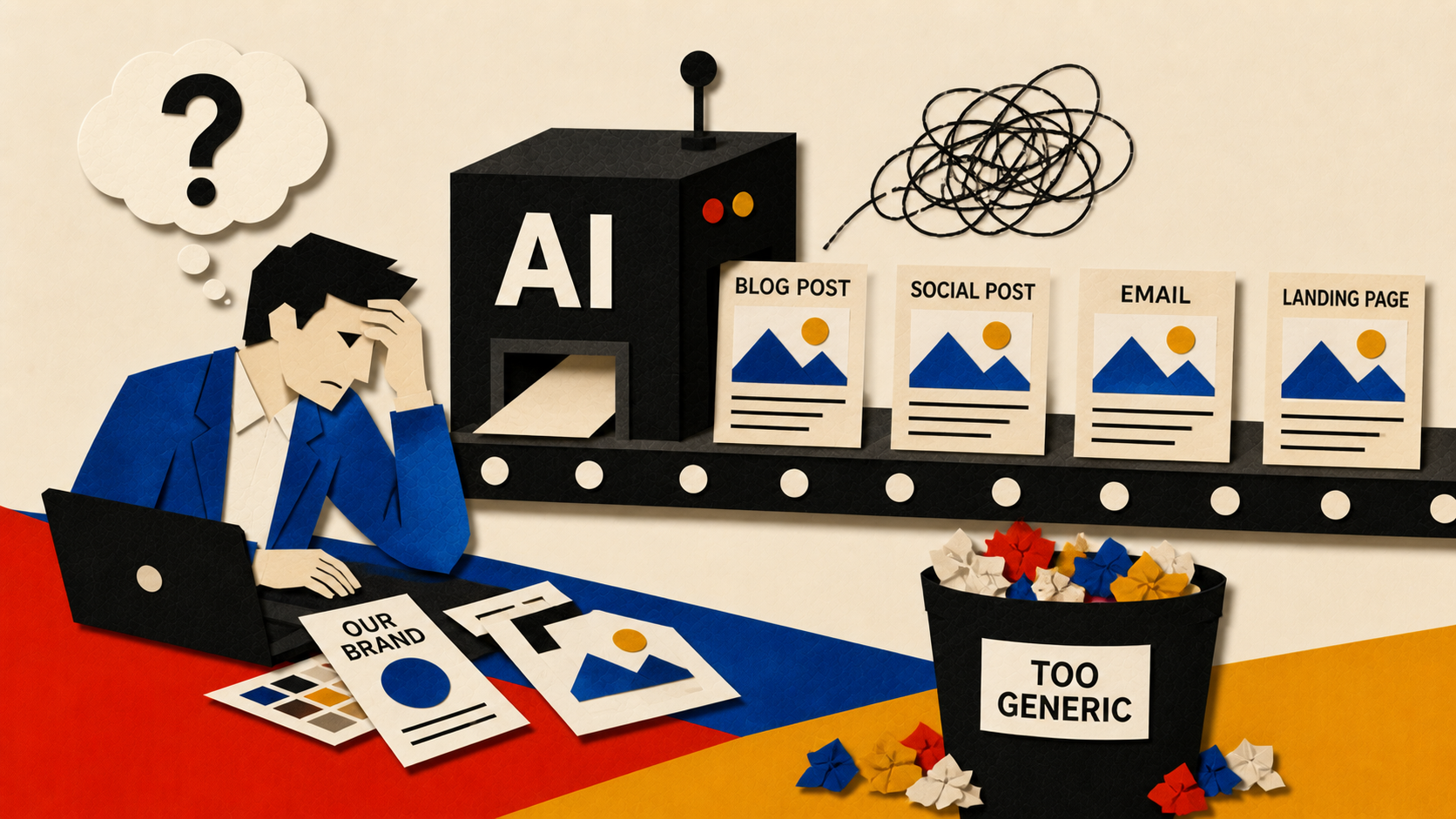
I call it the Context Vacuum. When you run any AI tool without a documented brand bible feeding it, you create a vacuum. The AI doesn't know your point of view, your category claim, your customer's exact pain, your villain, your vocabulary, what you say, what you refuse to say. So it does what it was trained to do: it fills the vacuum with the statistical average of everything it's seen on the internet for your industry.
Which is exactly the same vacuum your competitors' AI tools are filling. With the same averages. From the same internet.
That's why your AI-generated content sounds generic. Not because the model is weak. Because there's no YOU in the prompt for it to ground in.
Why this is worse now than ever
Two years ago, AI was a novelty. You'd open ChatGPT once a week, write a careful prompt, eyeball the output. The drift was contained because the volume was low.
Today AI is in every workflow. Marketing uses it for blog posts. Sales uses it for outbound. Support uses it for replies. Product uses it for spec docs. Operations uses it for SOPs. Every team, every freelancer, every contractor, every new hire walks in and immediately starts prompting an LLM about your company.
Each of them has a slightly different version of what your company is. The AI faithfully averages all of it. Then it scales that average across every output. Multiply that by a year of compounding, and your brand is no longer YOUR brand. It's the mean of how 12 different employees described you to ChatGPT in 12 different prompts.
By 2027, companies without a documented Context Engineering layer won't just sound generic. They'll be invisible. Invisible to buyers, who skim past sameness. Invisible to LLMs, who can't distinguish you well enough to recommend you. And invisible to their own teams, who keep re-inventing the wheel with every prompt.
The diagnostic - run this on your team
Before you run the internal test, run the outside-in one. Our free Brand Signal Score reads your homepage the way a model does and tells you in about a minute whether a machine can see who you're for and what you claim, or whether it's filling your Context Vacuum with the industry average. Same vacuum, showing up on the outside.
- 1Pick three people on your team. Without checking any documents, can each one write a paragraph about your company in the same voice, with the same villain, and the same category claim? If no, you have a Context Vacuum.
- 2Pull three AI-generated outputs from the last month: a LinkedIn post, an investor email, a customer onboarding doc. Read them side by side. Do they sound like the same company? Or three companies that happen to share a logo?
- 3Notice how often your CEO has to re-explain the company to a new freelancer, contractor, or AI-using marketer. Every re-explanation is context engineering you're doing manually instead of capturing once and re-using forever.
What I see across 100+ B2B companies
Companies treat "use AI" as a tool decision: which model, which subscription, which automation. It's not. It's an infrastructure decision. The AI itself is commodity. The Context Engineering layer is your moat.
About 9 in 10 B2B companies I've worked with in the last year had a Context Vacuum. Their AI tools were generating output, but the output wasn't theirs. It was a generic SaaS-shaped average. The 1 in 10 that had documented their brand bible (sometimes called an MMF, sometimes a brand book, sometimes just "the doc") were producing AI content that compounded their voice instead of diluting it. That documented-bible-plus-trained-model combination is what we mean by AI Brand Twin: Scaling Voice Without Losing Soul.
A real example
A $20M ARR SaaS company brought me in last quarter. Three marketers on staff. Two contractors. One in-house AI subscription. Six months of "AI-powered marketing." Pipeline was flat.
We did a content teardown. Pulled 60 days of LinkedIn posts, sales emails, blog drafts, and onboarding sequences. Read them all in one sitting. They didn't sound like one company. They sounded like five different companies that happened to share a logo. The CEO had given three different versions of the company story to three different teams. The AI faithfully averaged all of it.
We documented their Magnetic Messaging Framework as a 35-page Business Bible. Named the villain. Named the category. Captured the CEO's actual point of view in his own words, the words he'd never quite let his marketing team say out loud. Then we trained a custom GPT on the document and rolled it out to every team and every contractor.
Within 60 days, every output sounded like one company with one point of view. Not because we wrote different prompts. Because the AI now had something specific to ground in. Pipeline didn't just recover. It accelerated, because for the first time their voice was coherent across every channel.
What this means for you
Three things you can do this quarter without buying anything new:
- 1Audit your AI usage. List every tool and every team using AI for any customer-facing output. You'll be shocked at the surface area you didn't know you had.
- 2Document your brand bible as if you were training a new senior hire who'll never meet you. Capture: who you're for, what villain you're fighting, what category you own, what your real point of view is, what words you use, what words you refuse to use. The format doesn't matter. The capture does.
- 3Train your AI tools on it. Not "give them a fresh prompt every time." Train them once: custom GPT, Claude Project, Gemini Gem. The tool learns it once and references it forever. Every team prompting that trained AI is now prompting a Brand Twin instead of a generic average.
Questions People Ask
FAQ
Why does ChatGPT produce generic content for my company?
Because your prompt doesn't include your specific brand truth. ChatGPT defaults to the statistical average of everything it's seen for your industry. The fix isn't a better prompt, it's a Context Engineering layer (a Magnetic Messaging Framework or Brand Bible) that the AI tool learns from once and references forever.
What is a Magnetic Messaging Framework (MMF)?
An MMF is a documented brand bible that captures your point of view, category claim, named villain, customer's exact pain, vocabulary, and POV. It's the Context Engineering layer that any AI tool needs to produce content in your voice instead of the internet's average.
What is an AI Brand Twin?
An AI Brand Twin is an LLM (typically a custom GPT, Claude Project, or Gemini Gem) trained on your company's documented brand bible. It produces marketing, sales, and content output in your voice at scale, without your team having to re-explain the company in every prompt.
Why is my AI marketing content sounding the same as my competitors?
Because your competitors' AI tools are filling the same context vacuum with the same internet averages. The way out isn't a better tool ... it's documenting and training on your specific point of view, your specific villain, and your specific customer language.