
Newsflash: You're Now Marketing to Machines

By Greg Rosner
Founder of PitchKitchen · Author of StoryCraft for Disruptors
· 8 min read
TL;DR
Your buyers have stopped Googling. They're asking ChatGPT, Claude, Perplexity, and Google AI Overviews. And those machines are deciding who to recommend based on one thing: clarity. Not your ad spend. Not your domain authority. Not your logo. How clearly your website answers the question 'who is this for, what problem do they solve, and why should I care?' If your messaging is vague, narcissistic, or sounds like every competitor, you're invisible to the machines. Not penalized. Invisible. The companies with the clearest perspective will be the ones AI recommends. Everyone else disappears.
The rant
I'm going to say something that's going to make a lot of marketing leaders uncomfortable.
Your buyers are not reading your website anymore. Not the way you think they are. They're not scrolling through your homepage, clicking through your solutions pages, reading your blog posts, and then filling out a contact form.
They're asking a machine.
"Hey ChatGPT, what's the best AI scribe for FQHCs?" "Hey Claude, which B2B messaging consultants work with $5M-$75M SaaS companies?" "Hey Perplexity, who helps healthtech companies fix their sales deck?"
And the machine answers. With names. With recommendations. With reasons.
Here's the part that should terrify you: the machine is not recommending you. It's recommending whoever has the clearest answer to the buyer's question. And if your website is full of "comprehensive platform for modern enterprises" and "trusted partner in digital transformation" and "AI-powered solutions for today's challenges"... the machine doesn't know what you do. It can't tell you apart from the other 400 companies saying the exact same thing.
You're not being penalized. You're being ignored. There's a difference. Penalized means the machine saw you and ranked you low. Ignored means the machine never even considered you because your messaging gave it nothing to work with.
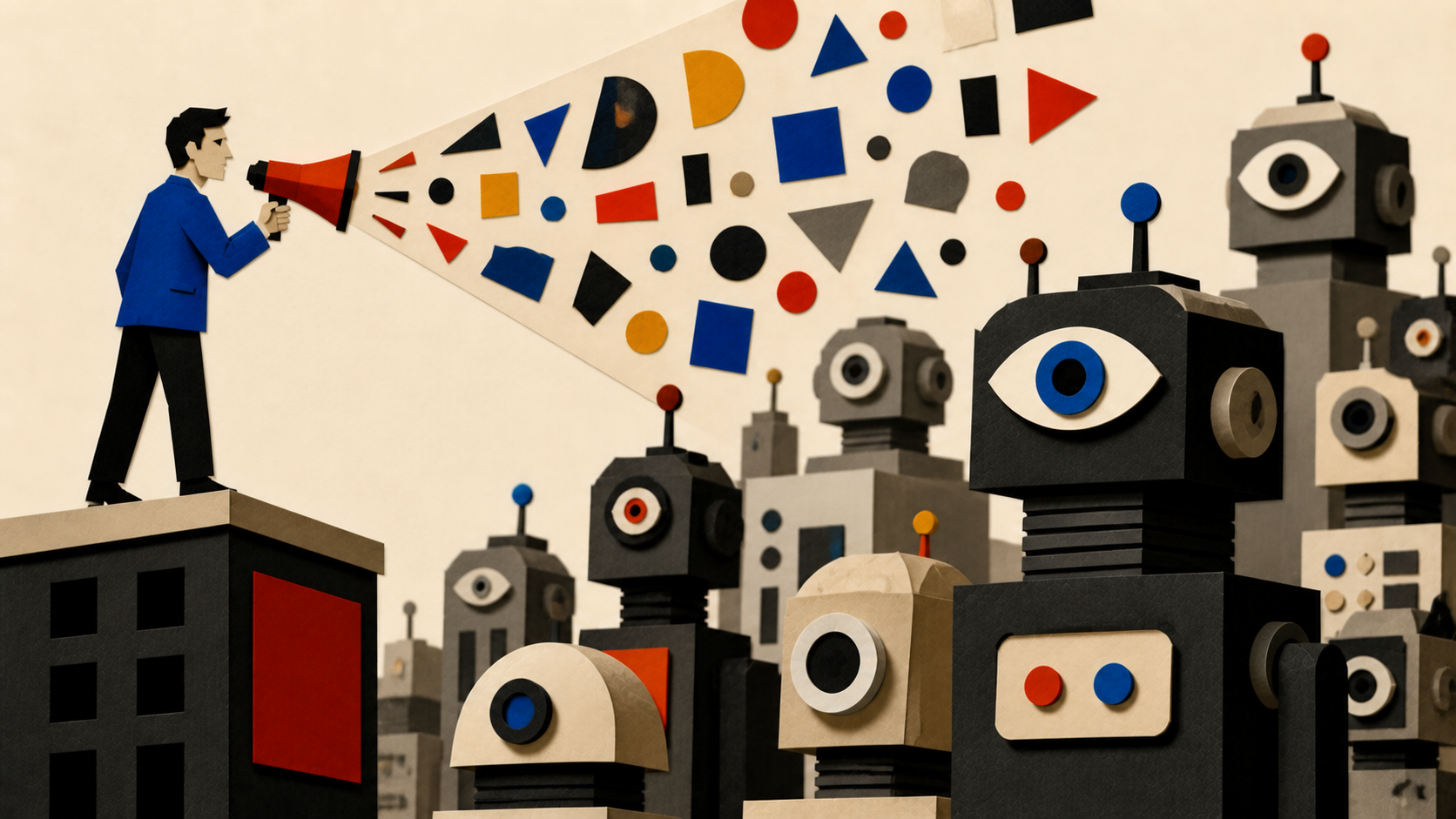
You are now marketing to machines. Whether you like it or not. And the machines don't care about your brand, your logo, your ad spend, or how long you've been in business. They care about one thing: clarity.
Naming what's actually broken
Here's what happened while most marketing teams were busy optimizing for Google's blue links.
The buying process changed. Fundamentally. A growing percentage of B2B buyers now start their research by asking an AI agent. Not by Googling. Not by asking a colleague. By typing a question into ChatGPT or Claude or Perplexity and reading whatever comes back.
And what comes back is determined by a completely different set of rules than what determined Google rankings.
Google ranked you based on authority. Backlinks. Domain age. Technical SEO. You could rank #1 for a keyword and say absolutely nothing meaningful on the page. Plenty of companies did.
AI agents rank you based on coherence. Does your website clearly state who you're for? Does it name a specific problem? Does it make a claim that's specific enough to cite? Does it answer the buyer's question in language that a machine can parse and repeat?
I call this LLM Invisibility. It's the state of having a website that looks fine to humans but is completely opaque to machines. Your homepage says "we help businesses grow." The machine reads that and thinks: that could be anyone. It could be a marketing agency, a SaaS platform, a consulting firm, or a lemonade stand. It's not useful. It's not quotable. It's not recommendable.
The machine recommends someone else instead. Someone whose website says "we help $5M-$75M B2B SaaS companies fix their sales conversion by rebuilding their messaging from the buyer's problem out." That's specific. That's parseable. That's quotable. That gets recommended.
The game changed and most companies are still playing the old one. If you want the rules of the new one, that's exactly what AEO Strategy: How to Rank in ChatGPT, Gemini, Perplexity, and Claude lays out.
Why this is worse now than ever
Let me give you some numbers that should keep you up tonight.
ChatGPT has over 400 million weekly active users as of early 2026. Perplexity processes millions of queries a day. Google AI Overviews now appear on the majority of search results, answering the question before the user ever clicks a link. Claude is being used by enterprises for everything from vendor evaluation to procurement research.
Your buyers are using these tools. Right now. Today. Not theoretically. Not "in the future." This morning.
And here's the compounding problem. AI agents learn from each other's outputs. If ChatGPT doesn't recommend you, Perplexity probably won't either. Because they're both pulling from the same web content, and if your content doesn't clearly answer the question, none of them will surface you.
It's a visibility death spiral. Vague messaging leads to AI invisibility. AI invisibility leads to fewer buyer interactions. Fewer buyer interactions leads to less market presence. Less market presence leads to even less AI visibility.
Meanwhile, your competitor whose website opens with "Every day your clinicians spend 90 minutes on charting that should take zero. We fix that. Here's how." is getting recommended in every AI query about clinical documentation. Not because they paid for placement. Because they were clear.
The irony is brutal. Most companies spend $50K-$100K on SEO. They've got the backlinks. They've got the domain authority. They've got the technical optimization. And none of it matters if the AI agent reads their homepage and can't figure out what they actually do.
The diagnostic... run this on your website right now
If you want the machine's-eye view without running every test by hand, our free Brand Signal Score reads your homepage the way an AI agent does and scores whether it can tell who you're for, what problem you solve, and why you're the answer. It's the fastest way to find out if you're quotable or invisible before you change a single word. Then run the three tests below to confirm what it finds.
- 1The AI Recommendation Test. Open ChatGPT (or Claude, or Perplexity). Type: 'What are the best [your category] companies for [your specific buyer]?' Read what comes back. Are you mentioned? If not, you're invisible. If you are mentioned but the description is wrong or generic, your messaging is leaking. Try three variations of the query. If you don't appear in any of them, the machines don't know you exist.
- 2The Quotability Test. Pull up your homepage. Read the first three sentences. Now imagine an AI agent needs to recommend you to a buyer. Can it quote any of those sentences verbatim and have them make sense? 'We're the leading platform for...' fails this test. Nobody is going to hear that from a machine and think 'that's who I need.' 'The only AI scribe with a human at the center, catching hallucinations before they hit the chart' passes. It's specific. It's differentiated. It's quotable.
- 3The Cover-the-Logo Test, Machine Edition. Take your homepage. Remove your company name and logo. Now feed the text to ChatGPT and ask: 'Based on this content, what does this company do, who is it for, and why would someone choose them over a competitor?' If the AI can't answer those three questions from your content alone, neither can any AI agent evaluating you for a buyer. And that means you're invisible.
What I see across 200+ B2B companies
I've run the AI Recommendation Test on over 200 B2B company websites. Here's what I keep finding.
8 out of 10 are completely invisible to AI agents. Not penalized. Not ranked low. Invisible. The machines don't mention them at all because their websites don't contain a single sentence specific enough to quote. That's the deeper story behind why AI doesn't cite your B2B company when buyers ask for recommendations.
The companies that do get recommended share three characteristics. First, they name a specific buyer. Not "enterprises" or "businesses." A specific type of organization with a specific problem. Second, they lead with the problem, not the solution. The AI agent is trying to match a buyer's question to an answer. If you lead with your solution, you're answering a question nobody asked. Third, they make claims that are specific and defensible. "98% of notes signed within 2 hours" beats "streamlined documentation." "Saves clinicians 90 minutes per day" beats "improves efficiency." Specificity is what machines can grab onto.
Here's the thing that should really change how you think about your website. Your website is no longer just a brochure for humans. It's a resume that machines read on your behalf. Every time a buyer asks ChatGPT for a recommendation in your category, the machine is essentially scanning the web and deciding whether your "resume" is worth mentioning. If your resume says "experienced professional with a passion for excellence," you're not getting the interview. If it says "rebuilt the messaging for 200+ B2B companies, average pipeline increase of 40% within 90 days," you might.
The rules of marketing just changed. You're not just writing for the person who lands on your site. You're writing for the machine that decides whether anyone lands on your site at all.
A real example
$15M ARR B2B software company. Supply chain vertical. Good product. Real customers. Solid NPS.
We ran the AI Recommendation Test. Asked ChatGPT: "What are the best supply chain visibility platforms for mid-market manufacturers?" They weren't mentioned. Asked three more variations. Nothing.
Their competitor, roughly the same size, was mentioned in every single query. With a specific, accurate description of what they do and who they serve.
The difference wasn't product quality. It wasn't reviews. It wasn't domain authority. We checked. Our client actually had stronger SEO metrics across the board.
The difference was messaging clarity.
The competitor's homepage opened with: "Mid-market manufacturers lose an average of $2.3M annually to supply chain blind spots. We make every shipment, every supplier, and every delay visible in real-time. Before it costs you."
Our client's homepage opened with: "The comprehensive supply chain platform for modern enterprises."
One of those is machine-quotable. The other is machine-ignorable.
We rebuilt the messaging. Named the buyer (mid-market manufacturers with 50-500 suppliers). Named the problem ($2.3M in annual losses from visibility gaps). Named the villain (the legacy "trust and hope" approach to supply chain management that most companies are still running).
Four weeks later, we ran the AI Recommendation Test again. They appeared in 3 of 4 ChatGPT queries. With accurate descriptions. With their specific claims cited.
They didn't change their product. They didn't buy backlinks. They didn't run ads. They changed what they said about themselves so clearly that machines could finally understand it.
Organic demo requests increased 28% in the following 60 days. Not from SEO improvements. From AI agents recommending them to buyers who were asking the right questions.
What this means for you
The machines are already deciding who your buyers see. The only question is whether you're in the conversation or invisible.
- 1Run the AI Recommendation Test this week. Open ChatGPT, Claude, and Perplexity. Ask each one to recommend companies in your category for your specific buyer. If you're not mentioned, you know the problem. If you are mentioned but the description is wrong, your messaging is leaking and machines are misrepresenting you. Either way, you now have a baseline. And a reason to move.
- 2Run the Machine Readiness Rubric. Answer these seven questions honestly. If you can't answer yes to all seven, you're invisible to the machines that are now deciding who your buyers see. Is your perspective clear? Does your website take a stance that a machine could summarize in one sentence? Are your capabilities positioned as the obvious choice? Not a list of features. A clear reason why your solution is the only one that makes sense for your specific buyer. Is the rebellion you're leading clear? Every company worth following is fighting against a status quo. Can a machine tell what yours is? Is who this is for clear? Not 'enterprises.' Not 'businesses.' The specific buyer with the specific problem. Named. Explicitly. Is what you want them to do clear? What's the first step? Not 'book a demo.' The real first step in their transformation from how they're doing it today to how they should be doing it. Is how you're different clear? If a machine reads your homepage and your top competitor's homepage, can it tell you apart? Or do you both say 'comprehensive platform for modern [industry]'? Is your solution clear? Not your features. Your solution. The outcome. The change. What's true after they work with you that wasn't true before? Seven questions. If the machines can't parse the answers from your website, neither can the buyers who are asking those machines for help.
- 3Understand the new funnel. The old funnel was: Google search, click link, read website, fill out form. The new funnel is: ask AI agent, get recommendation, visit the recommended company's website, decide. If you're not in the AI agent's recommendation, you're not in the funnel at all. Your ad spend, your SEO, your content marketing... none of it matters if the machine that's answering your buyer's question doesn't know you exist. Clarity isn't a nice-to-have anymore. It's the entrance fee.
The companies with the clearest perspective will be the ones AI recommends. Everyone else disappears. Not slowly. Not gradually. They just stop showing up in the conversation. And most of them won't even know it happened until the pipeline dries up and nobody can figure out why. Your website isn't just talking to humans anymore. It's auditioning for machines. Make sure it knows its lines. If you answered no to more than two of those seven questions, your messaging needs work before anything else you spend on marketing will matter. We do clarity sessions. One conversation. No pitch. Just diagnosis. the 90-Day AI Website Rebuild
Questions People Ask
FAQ
How do AI agents like ChatGPT decide which companies to recommend?
They parse the web for the clearest, most specific answer to the user's question. If your website says 'comprehensive platform for modern enterprises,' that's too vague for an AI to recommend. If it says 'the only AI scribe with a human at the center, catching hallucinations before they hit the chart,' that's specific enough to be quoted. AI agents don't rank by authority or ad spend. They rank by clarity and relevance. The most specific answer wins.
What is AEO (Answer Engine Optimization)?
AEO is the practice of structuring your content so AI agents (ChatGPT, Claude, Perplexity, Google AI Overviews) can find, parse, and recommend it. It's different from SEO. SEO optimizes for search engine rankings. AEO optimizes for being the answer that AI agents cite. It requires clear problem statements, named buyer segments, specific outcome claims, and proof points that machines can extract and present to users.
Is my company invisible to AI?
Probably. Ask ChatGPT or Claude 'who are the best [your category] companies for [your ICP]?' If you're not mentioned, you're invisible. Not because you're bad. Because your messaging is too vague for a machine to know what you do, who you do it for, and why anyone should care. The fix isn't SEO tricks. It's message clarity.
We're a $5M to $75M B2B company. How do we find out if AI is recommending us or ignoring us?
Start with the free Brand Signal Score at pitchkitchen.com/brand-signal-score. It reads your homepage the way ChatGPT and Claude do and scores whether a machine can tell who you're for, what problem you solve, and why you're the answer. Then ask the AI agents directly: 'who are the best [your category] companies for [your buyer]?' If you're a $5M to $75M B2B company with a real product and you're still not mentioned, the gap isn't your product or your SEO. It's that your messaging is too vague for a machine to quote. That's a clarity problem, and it's fixable.