
The 2026 Healthtech Messaging Index
Navina
navina.ai·scored September 1, 2026
19/38
Invisible
The page is doing some work, but the story isn't landing fast enough. Buyers and AI are both left guessing what makes Navina different.
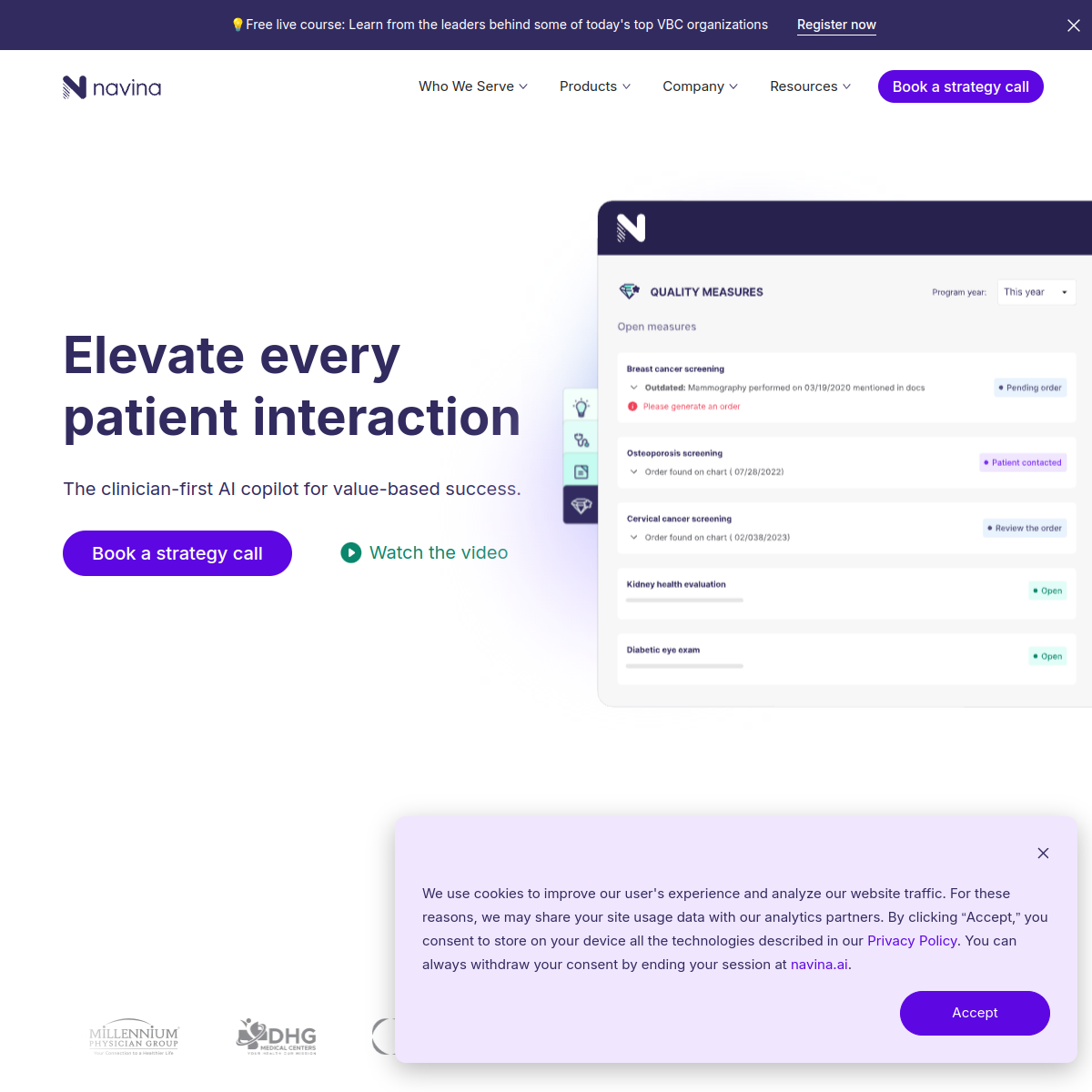
The page we scored
The AI Recommendation Check
When we asked AI who to recommend for AI clinical copilot for value-based care and risk adjustment, it named:
Buyer we put in the prompt: Chief Medical Officer, Chief Clinical Officer, or Director of Risk Adjustment at a value-based care organization or primary care medical group. Both the buyer and the category were inferred from Navina’s homepage alone. The model had no web access.
Navina was on the list.
AI named them for their own category. That's the signal every homepage is supposed to send.
AI named you when asked who it recommends for "AI clinical copilot for value-based care and risk adjustment", and described you accurately: "Navina is an AI-powered patient intelligence platform that synthesizes complex medical records at the point of care to surface HCC coding opportunities, care gaps, and clinical insights to help value-based care organizations improve risk adjustment accuracy.". Your positioning is landing with the machines.
Overall assessment
Navina's biggest strength is its dense, credible social proof: named testimonials with titles and organizations, a #1 KLAS ranking, and concrete engagement metrics (86% weekly active providers, 3.5M+ lives) that competitors can't easily replicate. The biggest gap is the complete absence of problem leadership and cost-of-inaction framing ... the page never names the pain (burnout, missed HCC codes, failed audits) before pitching the solution, which means skeptical buyers have no emotional hook to justify urgency or change.
Signal by category
Narrative Clarity
8 signals
Trust Signal
4 signals
AI Signal
6 signals
Conversion Signal
1 signal
Weakest signal · fix this first
02Rebellion / Movement
“No named enemy, no named status quo, no industry pattern called out anywhere on the page.”
There is no rebellion framing ... no named villain (fragmented EHRs, fee-for-service inertia, administrative overload) that Navina is pushing against; the page sells features, not a movement.
All 19 signals, scored 0 to 2.
Total 19/38
Narrative Clarity
8 signals
- 1
01The 7-Second Test
“Elevate every patient interaction" / "The clinician-first AI copilot for value-based success.”
Value-based care and clinicians are identifiable in 7 seconds, but 'elevate every patient interaction' is vague aspiration ... a caveman still can't explain what the product does or what specific problem it solves.
- 0
02Rebellion / Movementweakest
“No named enemy, no named status quo, no industry pattern called out anywhere on the page.”
There is no rebellion framing ... no named villain (fragmented EHRs, fee-for-service inertia, administrative overload) that Navina is pushing against; the page sells features, not a movement.
- 1
03Owned Language & Category
“clinician-first AI copilot" and "value-based workflows from the back office to the point-of-care”
'Clinician-first AI copilot' hints at a frame but is not a coined or owned term Navina formally names and defines; it's a descriptor any competitor could adopt without attribution.
- 1
04ICP Clarity
“The clinician-first AI copilot for value-based success.”
Clinicians in value-based care organizations are identifiable, but company size, specific roles (CMO vs. coder vs. primary care physician), or practice stage are never made explicit above the fold.
- 0
05Problem Leadership
“Elevate every patient interaction" ... page opens with aspiration, not a problem statement.”
The page leads with the product and its attributes, never naming the buyer's pain (e.g., clinician burnout, missed HCC codes, failed quality metrics) before presenting the solution.
- 1
06Solution Clarity
“Navina turns complex, fragmented data into actionable insights, transforming value-based workflows from the back office to the point-of-care.”
A visitor can form a rough one-sentence summary but 'actionable insights' is generic; the sentence doesn't specify whether Navina is a dashboard, a documentation tool, a coding assistant, or all three.
- 0
07Cost of Inaction
“No mention of what happens if buyers don't change ... no lost revenue, missed quality scores, or burnout costs named anywhere on the page.”
The cost of inaction is entirely absent; the page never states what a practice loses by staying with the status quo.
- 1
08Promised Land
“helping our team stay strong as a top-performing ACO" and "drastic increase in our overall patient risk adjustment scores”
A promised land is implied through testimonials but never painted explicitly by Navina itself in a dedicated 'after state' section with specific, measurable outcomes the buyer will achieve.
Trust Signal
4 signals
- 2
09Proof & Evidence
“86% weekly active providers" / "3.5M+ Lives impacted" / "Navina Quality Platform Boosts Performance by up to 24%" / "600+ AI algorithms”
Multiple concrete, specific numbers are present ... engagement rates, lives impacted, performance lift percentages ... giving buyers real proof points beyond adjectives.
- 2
10Social Proof
“Dr. Benjamin Cook, Family Medicine Physician, Jefferson City Medical Group" / "Dr. Keith Fernandez, Chief Clinical Officer, Privia Health”
Named testimonials with full name, title, and organization are abundant, paired with logos and video proof; this is well-executed social proof.
- 1
11Authority & Credibility
“Navina's AI copilot ranks #1 in 2025 Best in KLAS" / "second consecutive KLAS award”
KLAS rankings are third-party validation and meaningful in healthcare, but there are no founder credentials, original research, or published frameworks ... authority rests solely on awards and customer logos.
- 0
12Alternatives Acknowledged
“No mention of competitors, alternative approaches, or 'do nothing' option anywhere on the page.”
The page never acknowledges what buyers are currently doing instead, making it impossible for a skeptical buyer to understand why Navina wins against the status quo or named alternatives.
AI Signal
6 signals
- 1
13Customer Focus
“it's going to be a game changer" / "it helps me identify problems that I didn't realize were there”
Testimonials put the customer as protagonist, but the product sections ('Superior AI,' 'Trusted and transparent,' 'Loved by clinicians') tilt toward company capabilities, making it a mixed narrative.
- 1
14AI-Parmesan Index
“600+ AI algorithms for primary care" / "Explainable AI provides clinical evidence for every insight surfaced”
'Explainable AI' with clinical evidence is a step toward mechanistic specificity, but '600+ AI algorithms' is a number without explanation of what they do, and 'AI-powered' language appears without deeper mechanism detail.
- 1
15LLM Quotability
“Navina turns complex, fragmented data into actionable insights, transforming value-based workflows from the back office to the point-of-care.”
This sentence is clean and declarative but too generic to be uniquely attributable to Navina; an LLM would find it quotable but not distinctively citable over a competitor's similar claim.
- 1
16Copyright Freshness
“Navina's AI copilot ranks #1 in 2025 Best in KLAS" ... 2025 news item visible; no visible copyright year in scraped content.”
A 2025-dated news item signals recency, but no explicit copyright year is visible in the scraped content and no dated blog posts or case studies appear on the homepage.
- 2
17Entity Distinctiveness
“Best in KLAS clinician copilot" / "clinician-first" / "600+ AI algorithms for primary care" / explicit value-based care + HCC + HEDIS focus”
The combination of KLAS #1 ranking, clinician-first framing, HCC/HEDIS specificity, and value-based care workflow coverage is distinctive enough that an AI could differentiate Navina from generic clinical AI competitors.
- 2
18AI Recommendation Check
“AI described you as: "Navina is an AI-powered patient intelligence platform that synthesizes complex medical records at the point of care to surface HCC coding opportunities, care gaps, and clinical insights to help value-based care organizations improve risk adjustment accuracy.”
AI named you when asked who it recommends for "AI clinical copilot for value-based care and risk adjustment", and described you accurately: "Navina is an AI-powered patient intelligence platform that synthesizes complex medical records at the point of care to surface HCC coding opportunities, care gaps, and clinical insights to help value-based care organizations improve risk adjustment accuracy.". Your positioning is landing with the machines.
Conversion Signal
1 signal
- 1
19Path & CTA Clarity
“Book a strategy call" (primary CTA) / "Watch the video" (secondary CTA) ... no numbered process or workflow steps shown.”
Two CTAs exist and are differentiated, but there is no visible numbered path or clear process explaining what happens after you book, so the conversion journey is incomplete.
Keep the lead
AI already names Navina. The next edition decides if it still does.
Twenty minutes with Greg. Bring the page, bring the argument. You’ll leave knowing exactly which signal is costing Navina the AI recommendation, and what to write instead.
Not on the list? Run your homepage through the free Brand Signal Score and see where you’d land. Same 19 signals, same AI check, two minutes.