
Your Story,
Installed in AI.
A custom AI assistant trained on your documented messaging framework, so every draft your team ships sounds like your company and sells your story. Built inside the 90-Day AI Website Rebuild. You own every layer.
The definition
What is an AI Brand Twin?
An AI Brand Twin is a custom AI assistant, built as a private MCP server the whole team connects to from Claude, ChatGPT, Cursor, or the AI they already use (or as a Claude Project, Custom GPT, or Gemini Gem where a team standardizes on one), trained on a company's Magnetic Messaging Framework through three stacked layers: Knowledge (the documented strategy), Behavior (a system prompt carrying guardrails and tone rules), and Per-task Style (a Voice Spec with format-by-format writing rules). The result writes in the company's voice instead of the average of the internet.
PitchKitchen coined the term and builds one for every Rebuild client. The deeper explainer lives on the blog: What is an AI Brand Twin, and how do you build one?
The architecture
Three stacked layers. Zero hand-waving.
Every AI Brand Twin has the same technical anatomy. Each layer is a document you can read, edit, and take with you. Would your current AI setup survive that level of inspection?
01
Knowledge
What to say
Lives in: Knowledge file inside the assistant
Your complete Magnetic Messaging Framework, 35+ documented sections: best-fit customer, the old game and the new game, your only-we claim, beliefs, proof, objection handling, the full strategic verbal identity. This is the layer most companies skip, and it's why their AI output sounds like everyone else's. The model can't cite a strategy that was never written down.
02
Behavior
How to act
Lives in: System prompt of the assistant
The standing instructions that govern every response: source-of-truth rules (the MMF wins over the model's general knowledge), strategic guardrails (claims it must never make, positions it always holds), tone defaults, audience awareness, and the AI lingo detox, a banned-word list that strikes 'skyrocket,' 'unleash,' 'game-changer,' 'seamless,' 'revolutionize,' and the rest of the vocabulary that marks writing as machine-made.
03
Per-task Style
How to sound, format by format
Lives in: Voice Spec document, loaded per task
A cold email and a case study should share one voice with entirely different structures. The Voice Spec covers 15 formats, from blog posts to landing pages to call scripts, each with its own length targets, opening moves, point of view, tone register, structure, close, and forbidden constructions. This layer is what turns vibes-based feedback ('this doesn't sound like us') into rule-based feedback the AI actually follows.
Layer 1, made real
This is what a documented strategy looks like.
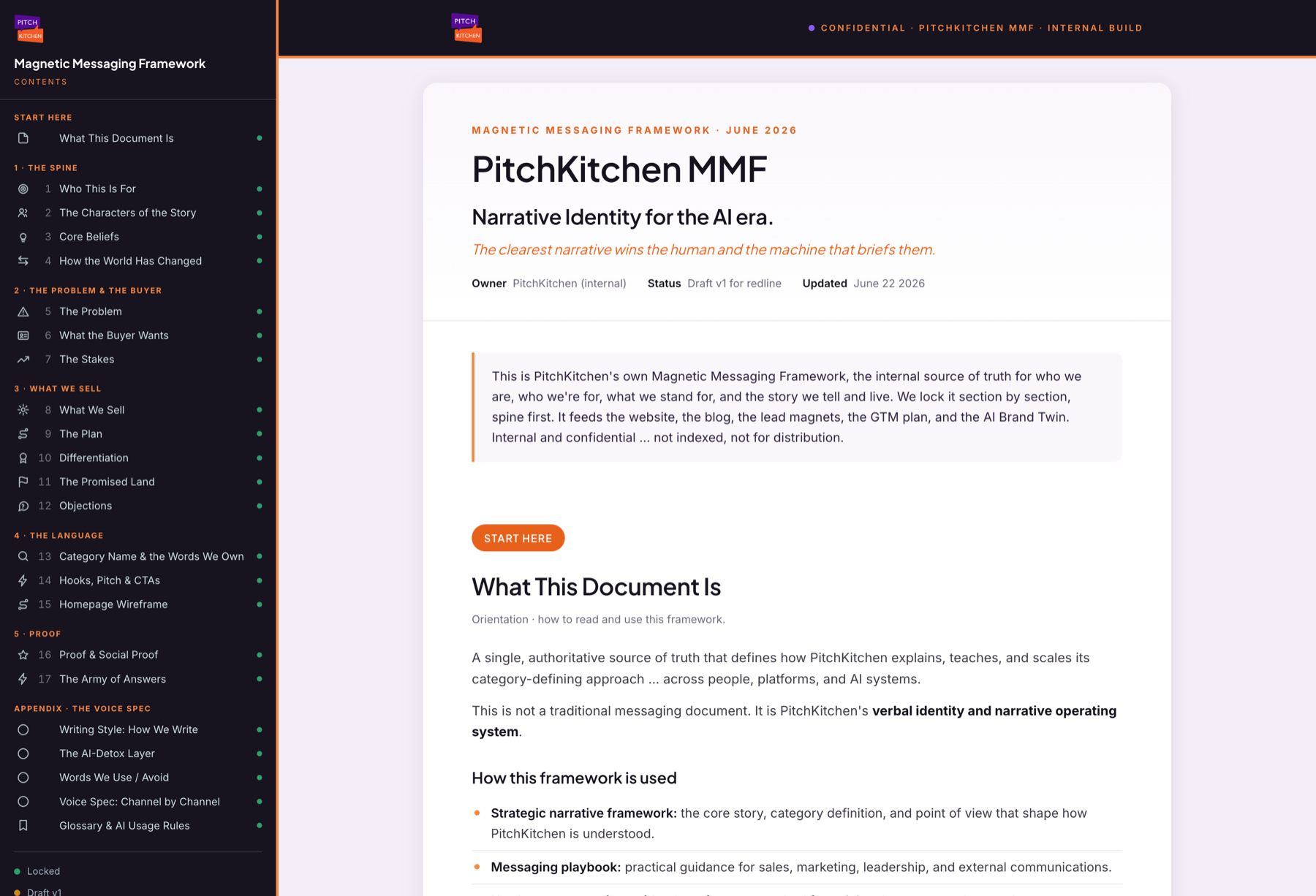
We eat our own cooking. This is a live look at PitchKitchen's own Magnetic Messaging Framework: 31 numbered sections and a full Voice Spec appendix, the internal source of truth that trains our own Brand Twin. Every Rebuild client gets their own version of this, and it becomes the Knowledge layer the AI reads first.
Straight answer
What an AI Brand Twin isn't.
No fine-tuning. No proprietary model. No black box. An AI Brand Twin runs on the frontier model your team already uses, through what engineers call context engineering: a knowledge file, a system prompt, and a style spec working together.
That design is the point. Because all three layers are documents you own, your Twin migrates to a better model the week one ships. Nothing about your brand gets locked inside a vendor's training run, and nothing depreciates when the AI landscape shifts. The hard part was never the AI. The hard part is the documented truth the AI gets trained on, and that's why the Magnetic Messaging Framework comes first.
Anyone promising you a "custom-trained brand AI" without a documented messaging framework underneath is selling you a clever prompt. Ask to see the layers.
In practice
What your team does with it Monday morning.
Sales follow-ups and proposals
Reps draft in the company voice instead of their own best guess. The deal story stays consistent from first call to contract.
Founder-voice LinkedIn and thought leadership
Posts that sound like the founder on a good day, grounded in the documented point of view instead of recycled platitudes.
Blog posts and case studies
Long-form content that carries the strategic narrative and survives the 'did a robot write this?' sniff test.
One-pagers, battlecards, and talk tracks
Every enablement asset translates the same source narrative, so buyers hear one company no matter which asset they touch.
AI brought the cost of content to zero. Volume is no longer the moat. Perspective is. Lived truth is. The Twin exists so scaling your content scales your story instead of diluting it.
Brand Twin over MCP
Everyone connects to one Twin.
Your reps draft in ChatGPT. Marketing writes in Claude. Someone on the product team lives in Cursor. The question is how every one of those AIs works from the same story.
One way: a shared space
Everyone loads a copy.
Put the framework in a shared project or shared space and ask everyone to work from it. It works while the team is small and someone owns keeping every copy current. As the team grows, copies drift, and people quietly work from last quarter's version.
Our recommendation: MCP
Everyone connects to one.
Your Twin lives on a private MCP (Model Context Protocol) server. Every person connects to it from Claude, ChatGPT, Cursor, or the AI they already use. Update the framework once and every connected AI works from the new version that same minute.
There's more than one way to slice the cheese, and we'll set up whichever fits your team. We recommend MCP because it guarantees the single source of truth: there's only one copy to keep right. We run our own the same way: the Test Kitchen MCP.
The build
How you get one.
The AI Brand Twin ships as a core deliverable of the 90-Day AI Website Rebuild, the fixed-price rebuild of your story, your website, your sales presentation, and your AI layer. $15,000 to $45,000 depending on scope. You own everything at the end.
Step 1
Document the truth first
The Rebuild opens with truth extraction: interviews with you, your team, and your customers, distilled into the Magnetic Messaging Framework. No Twin gets built on an undocumented story.
Step 2
Install the three layers
We build the Twin as a private MCP server the whole team connects to, or on a single platform if that fits your team better: MMF loaded as knowledge, the behavioral system prompt written and tested, the Voice Spec drafted format by format against your real content.
Step 3
Train the team, tune for 60 days
Your team learns to work with the Twin, and the Voice Spec gets revised against real output. Anything that proves wrong in the first 60 days gets fixed. After that, quarterly tune-ups.
Questions
What founders ask about the Twin.
What is an AI Brand Twin?+
An AI Brand Twin is a custom AI assistant, built as a private MCP server the whole team connects to from Claude, ChatGPT, Cursor, or the AI they already use (or as a Claude Project, Custom GPT, or Gemini Gem where a team standardizes on one), trained on a company's Magnetic Messaging Framework through three stacked layers: Knowledge (the documented strategy), Behavior (a system prompt carrying guardrails and tone rules), and Per-task Style (a Voice Spec with format-by-format writing rules). The result writes in the company's voice instead of the average of the internet.
Is an AI Brand Twin a fine-tuned model?+
No. Nothing is fine-tuned and no custom model gets trained. An AI Brand Twin is context engineering on top of a frontier model you already use: a knowledge file, a system prompt, and a style spec. That design is deliberate. Because every layer is a document you own, your Twin moves to a better model the week one ships, and nothing about your brand is locked inside a vendor's training run.
Which AI platforms can an AI Brand Twin run on?+
Our recommended setup is a private MCP server: everyone connects to one Twin from Claude, ChatGPT, Cursor, or whatever AI they already use, and one update reaches every tool at once. The three layers are platform-independent documents, so the same Twin also installs as a Claude Project, a Custom GPT, or a Gemini Gem when a team standardizes on one platform.
Should our team use a shared project or an MCP server for the AI Brand Twin?+
Both work, and there's more than one way to slice the cheese. A shared project or shared space means everyone loads a copy of the framework, which works while the team is small and someone owns keeping every copy current. An MCP (Model Context Protocol) server means everyone connects to one Twin. Update the framework once and every connected AI works from the new version that same minute. We recommend MCP because it guarantees the single source of truth: there's only one copy to keep right.
Do we need a Magnetic Messaging Framework before building an AI Brand Twin?+
Yes. The Twin is only as good as the truth it's trained on. Point AI at a company with undocumented, inconsistent messaging and it amplifies the inconsistency. The Magnetic Messaging Framework comes first because it's the documented strategic layer, 35+ sections of who you're for, what you stand for, and the story you tell. That document is Layer 1 of the Twin.
How much does an AI Brand Twin cost?+
The AI Brand Twin ships as a core deliverable of the 90-Day AI Website Rebuild, a fixed-price engagement between $15,000 and $45,000 depending on scope. The Rebuild delivers the story in writing (the Magnetic Messaging Framework), the website rebuilt on it, the sales presentation, and the Twin, and you own everything at the end. It carries the guarantee: AI names you 2X as often on your buyers' top 10 questions in 90 days, or we keep working on our dime.
How is an AI Brand Twin different from pasting brand guidelines into ChatGPT?+
A pasted prompt evaporates when the chat ends, and brand guidelines describe how things should look far more than how the company thinks. The Twin persists across every session and every teammate because the three layers live inside the assistant itself: full strategic knowledge, standing behavioral guardrails, and per-format style rules. Ask both to write the same sales email and the difference is obvious in one read.
We rebuild websites with AI so AI actually recommends you.
Hear your own voice
One Story. Every Channel. At AI Speed.
The Twin gets built in the last month of the Rebuild, on a foundation of documented truth. The conversation about whether your story deserves one takes thirty minutes.
Last updated: