
The 2026 Healthtech Messaging Index
Trek Health
trekhealth.io·scored September 1, 2026
15/38
Weak
The signal is faint. Most of this page is about Trek Health, not the buyer, and AI has little it can repeat. There's a lot of room to move.
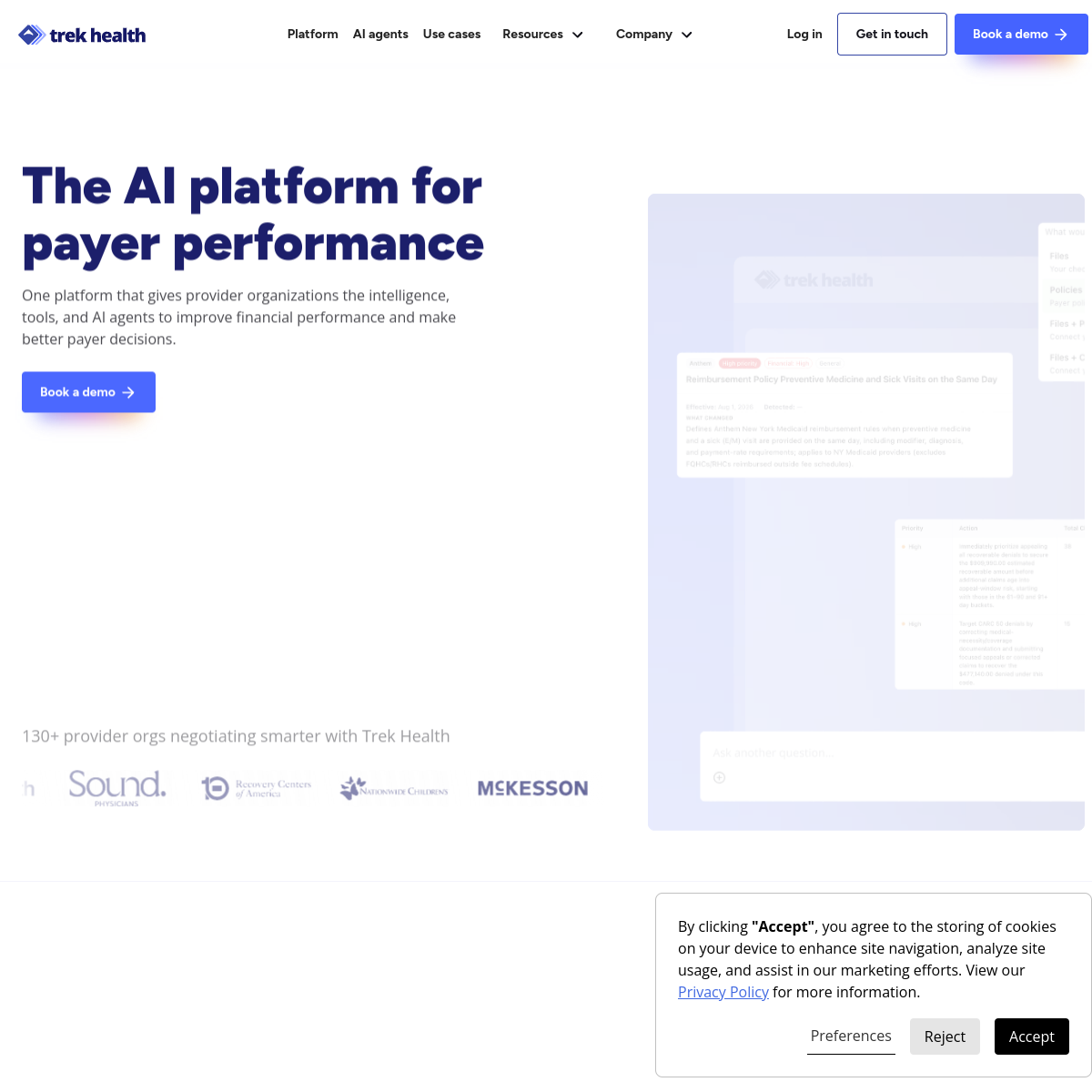
The page we scored
The AI Recommendation Check
When we asked AI who to recommend for AI-powered payer contract management and reimbursement optimization software for provider organizations, it named:
Buyer we put in the prompt: VP of Managed Care, SVP of Contracting, or Revenue Cycle Director at a hospital system or large provider organization. Both the buyer and the category were inferred from Trek Health’s homepage alone. The model had no web access.
Trek Health was not on the list.
A buyer who asked AI this question got 8 names and moved on. Trek Health never came up.
We asked AI who it recommends for "VP of Managed Care, SVP of Contracting, or Revenue Cycle Director at a hospital system or large provider organization" looking for "AI-powered payer contract management and reimbursement optimization software for provider organizations". It named Experian Health, Waystar, Optum (iEDI/Contract Manager), Nthrive, Strata Decision Technology. You did not appear. AI can't recommend what it can't clearly understand.
Overall assessment
Trek Health's biggest strength is its concrete proof: named organizations, specific percentage outcomes (30% inpatient reimbursement increase, 80%+ contract research time reduction), and recognizable customer logos give it credibility that most competitors lack on the homepage. The biggest gap is the complete absence of problem leadership and cost-of-inaction framing ... the page never articulates what pain the buyer is living in today or what staying with the status quo costs them, which means visitors who aren't already sold on the category have no emotional hook to drive urgency.
Signal by category
Narrative Clarity
8 signals
Trust Signal
4 signals
AI Signal
6 signals
Conversion Signal
1 signal
Weakest signal · fix this first
05Problem Leadership
“The AI platform for payer performance" ... page leads with the solution, not the buyer's pain.”
The hero jumps straight to the platform and its capabilities; no problem statement in the buyer's language appears before the solution pitch.
All 19 signals, scored 0 to 2.
Total 15/38
Narrative Clarity
8 signals
- 1
01The 7-Second Test
“The AI platform for payer performance”
The headline names the category and audience (provider organizations) but 'payer performance' is jargon that requires healthcare insider knowledge; a caveman wouldn't instantly grasp the problem being solved.
- 1
02Rebellion / Movement
“Replace disconnected tools and manual processes with a platform built for modern provider organizations.”
There's an implied enemy (disconnected tools, manual processes) but no named status quo, no named competitor pattern, and no explicit rebellion framing that declares a point of view.
- 1
03Owned Language & Category
“The payer performance platform”
Trek coins 'payer performance platform' and uses 'payer performance' repeatedly, hinting at a category frame, but never formally names or owns it as a defined category AI could cite independently.
- 1
04ICP Clarity
“From independent physician groups to leading health systems”
Provider organizations are identified as the buyer but role (VP of Managed Care? CFO? Revenue Cycle Director?) is never named, and company size/stage guidance is vague.
- 0
05Problem Leadershipweakest
“The AI platform for payer performance" ... page leads with the solution, not the buyer's pain.”
The hero jumps straight to the platform and its capabilities; no problem statement in the buyer's language appears before the solution pitch.
- 2
06Solution Clarity
“One platform that gives provider organizations the intelligence, tools, and AI agents to improve financial performance and make better payer decisions.”
A visitor can repeat in one sentence what Trek does: AI platform for provider organizations to improve reimbursement and payer decision-making.
- 0
07Cost of Inaction
“No cost-of-inaction statement anywhere on the page.”
The page never names what a provider organization loses by staying with current tools ... no revenue at risk, no leakage quantified in terms of doing nothing.
- 1
08Promised Land
“Maximize reimbursement, eliminate revenue leakage, and strengthen every payer relationship with one unified platform.”
The promised land is named but remains generic and adjective-heavy; no specific after-state (e.g., 'your team spends 80% less time on contract analysis') is painted vividly.
Trust Signal
4 signals
- 2
09Proof & Evidence
“30% increase in inpatient reimbursement achieved by Western Reserve Hospital" and "80%+ reduction in contract research time achieved by Family Allergy & Asthma”
Two named, specific before/after deltas with named organizations give concrete proof of outcomes, not just adjectives.
- 1
10Social Proof
“Trek enabled a 15% rate increase with Cigna. SVP, Contracting, Catalyst Health Group”
One named testimonial with title and company plus recognizable logo brands exists, but there are no video stories, no full case study quotes on-page, and only one attributed testimonial visible.
- 0
11Authority & Credibility
“No founder credentials, original research, awards, frameworks, books, or podcasts mentioned on the page.”
Authority is entirely absent; Trek claims capability but demonstrates no third-party validation, named expertise, or original thought leadership on the homepage.
- 0
12Alternatives Acknowledged
“No mention of competitors, alternative approaches, or 'do nothing' consequences anywhere on the page.”
The page never acknowledges what buyers are currently using or why Trek is better than those alternatives, leaving comparison entirely to the buyer's imagination.
AI Signal
6 signals
- 1
13Customer Focus
“help your team make faster, more profitable decisions”
The page tilts toward company capabilities and platform features rather than consistently keeping the customer as protagonist; transformation language appears but capability-first framing dominates.
- 1
14AI-Parmesan Index
“Replace manual analysis with AI-powered intelligence and automation" and "purpose-built AI agents”
AI agents are named with specific workflow categories (market intelligence, contract, policy, revenue) giving some mechanistic substance, but 'AI-powered intelligence' remains a generic sprinkle without explaining the underlying mechanism.
- 1
15LLM Quotability
“Trek Health helps organizations improve reimbursement, reduce revenue leakage, and strengthen payer performance.”
The sentence is clean but too generic to be citation-worthy; the stat sentences ('30% increase in inpatient reimbursement achieved by Western Reserve Hospital') are more quotable but lack the declarative framing an LLM would lift as a recommendation.
- 0
16Copyright Freshness
“No visible dates on case studies, blog posts, or copyright year found in scraped content.”
The scraped page contains no timestamp, publication date, or copyright year visible to AI crawlers, removing all recency signals.
- 1
17Entity Distinctiveness
“The payer performance platform" combined with named agent types: market intelligence, contract, policy, revenue agents.”
The specific combination of payer-focused AI agents and healthcare revenue context gives some distinctiveness, but the positioning could still describe several emerging health-tech platforms without the logo.
- 0
18AI Recommendation Check
“AI's picks: Experian Health, Waystar, Optum (iEDI/Contract Manager), Nthrive, Strata Decision Technology, Craneware. You were not named.”
We asked AI who it recommends for "VP of Managed Care, SVP of Contracting, or Revenue Cycle Director at a hospital system or large provider organization" looking for "AI-powered payer contract management and reimbursement optimization software for provider organizations". It named Experian Health, Waystar, Optum (iEDI/Contract Manager), Nthrive, Strata Decision Technology. You did not appear. AI can't recommend what it can't clearly understand.
Conversion Signal
1 signal
- 1
19Path & CTA Clarity
“Book a demo" (primary CTA) and "Learn more" (secondary links) ... no numbered steps or process visible.”
There is a primary CTA and soft secondary links but no visible numbered path or 'how it works' process connecting them, so only half the conversion signal framework is present.
Your move
Think Trek Health’s score is wrong? Good. Let’s look at it together.
Twenty minutes with Greg. Bring the page, bring the argument. You’ll leave knowing exactly which signal is costing Trek Health the AI recommendation, and what to write instead.
Not on the list? Run your homepage through the free Brand Signal Score and see where you’d land. Same 19 signals, same AI check, two minutes.