
The 2026 Healthtech Messaging Index
Vitable Health
vitablehealth.com·scored September 1, 2026
16/38
Invisible
The page is doing some work, but the story isn't landing fast enough. Buyers and AI are both left guessing what makes Vitable Health different.
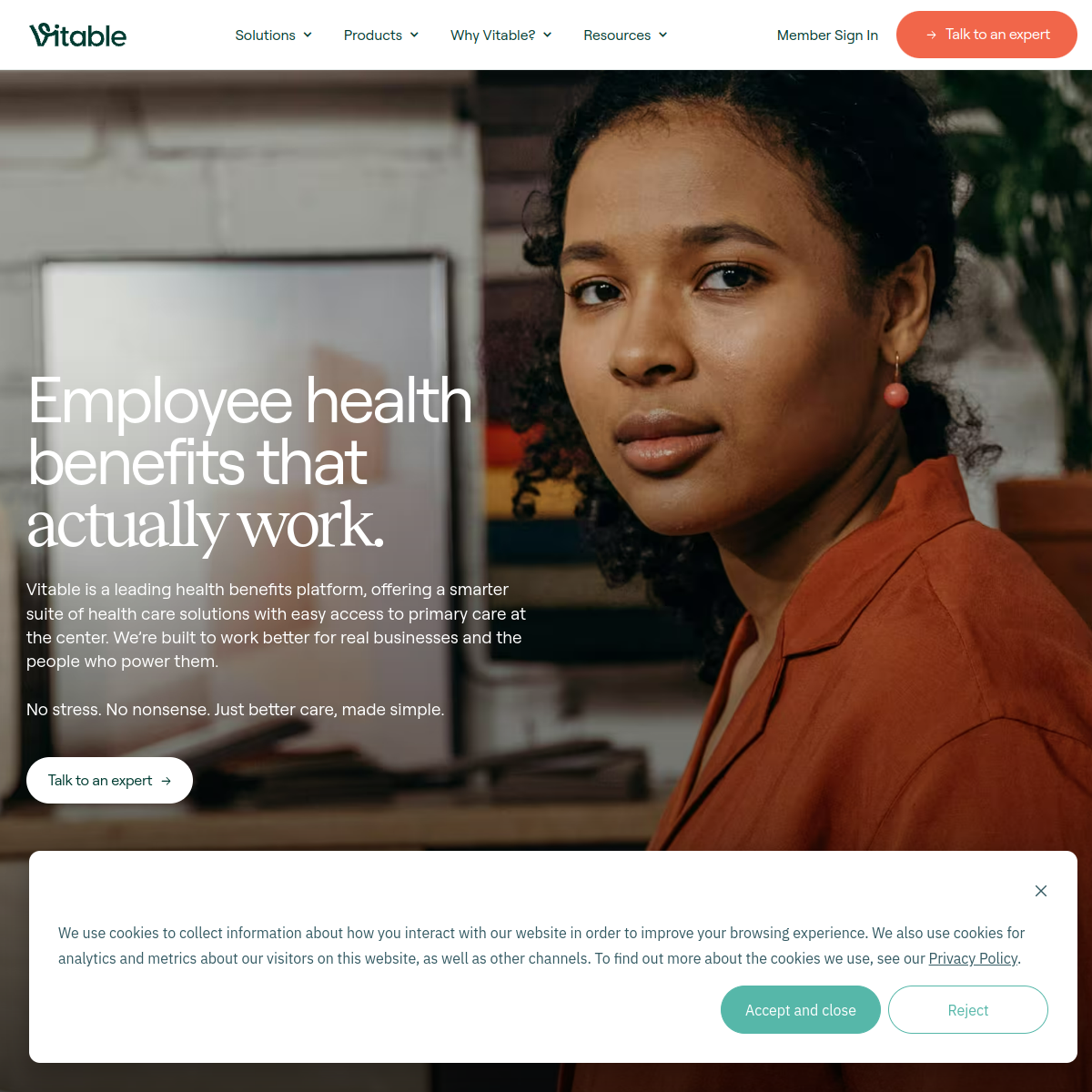
The page we scored
The AI Recommendation Check
When we asked AI who to recommend for employee health benefits platform combining direct primary care and health reimbursement arrangements (HRA/ICHRA) for small to mid-size employers, it named:
Buyer we put in the prompt: HR manager, operations director, or small business owner at a company with hourly or deskless workers (10 ... 500 employees) in industries like home care, restaurants, or transportation. Both the buyer and the category were inferred from Vitable Health’s homepage alone. The model had no web access.
Vitable Health was not on the list.
A buyer who asked AI this question got 8 names and moved on. Vitable Health never came up.
We asked AI who it recommends for "HR manager, operations director, or small business owner at a company with hourly or deskless workers (10 ... 500 employees) in industries like home care, restaurants, or transportation" looking for "employee health benefits platform combining direct primary care and health reimbursement arrangements (HRA/ICHRA) for small to mid-size employers". It named Stride Health, Take Command Health, Sana Benefits, Decent, Bind Benefits. You did not appear. AI can't recommend what it can't clearly understand.
Overall assessment
Vitable's biggest strength is its real, emotionally resonant testimonial volume and a clearly defined vertical focus (home care, restaurants, transportation) that helps industry-matched buyers self-identify quickly. The single biggest gap is the complete absence of concrete proof ... no numbers, no named customers, no before/after data ... which means the page tells buyers it's better without giving them a single verifiable reason to believe it.
Signal by category
Narrative Clarity
8 signals
Trust Signal
4 signals
AI Signal
6 signals
Conversion Signal
1 signal
Weakest signal · fix this first
09Proof & Evidence
“No statistics, percentage improvements, cost savings figures, or before/after deltas appear anywhere on the page.”
Every outcome claim is adjective-driven ('high-quality,' 'affordable,' 'better') with zero hard numbers, which means there's no evidence a buyer can verify or cite.
All 19 signals, scored 0 to 2.
Total 16/38
Narrative Clarity
8 signals
- 1
01The 7-Second Test
“Because health benefits should be better." / "Too many Americans still lack access to real care.”
The hero communicates a problem and a category (health benefits) but doesn't instantly clarify who the buyer is or what specific solution is offered ... a stranger would need to read further to understand this is an employer-facing B2B product.
- 1
02Rebellion / Movement
“Too many employers are stuck with options that don't work." / "Vitable was built to fix that”
There's a vague enemy (broken status quo in healthcare) but no named industry pattern, no specific villain called out ... it's a generic 'healthcare is broken' stance without a sharp, ownable point of view.
- 1
03Owned Language & Category
“ACA Autopilot" and "Vitable's VPC + ICHRA solution is truly the gold standard in virtual care”
'ACA Autopilot' is a coined product name that hints at owned language, but it's buried in a blog headline and never framed as a named category or framework the page owns prominently.
- 1
04ICP Clarity
“Home Care Agencies, Restaurants, Transportation, Non-Profits, Manufacturing, Hospitals, Startups, Childcares, Government”
Verticals are listed in a scrolling ticker but no specific company size, employee count, or buyer role is named, making ICP recognition dependent on industry match alone.
- 1
05Problem Leadership
“Too many Americans still lack access to real care. And too many employers are stuck with options that don't work.”
The problem is named but stated at a macro, societal level rather than in the specific language of the buyer's day-to-day pain ... no concrete problem scenario (e.g., losing hires, ACA penalty risk) leads the narrative.
- 1
06Solution Clarity
“better health benefits, made for today's workforce”
A visitor can grasp the general category but cannot explain in one sentence what Vitable actually does ... the hero doesn't clearly distinguish whether they're an insurer, broker, platform, or benefits administrator.
- 1
07Cost of Inaction
“Stay protected from ACA penalties without overpaying for health insurance premiums”
ACA penalty risk is mentioned once in the product section but is never dramatized as a cost of inaction in the hero or a dedicated narrative section ... it's present but not front-and-center.
- 1
08Promised Land
“When healthcare works, employees stay and businesses thrive.”
There's a promised land sentence but it's aspirational and generic ... no specific 'after' metrics like retention rates, cost savings, or enrollment numbers make it concrete and believable.
Trust Signal
4 signals
- 0
09Proof & Evidenceweakest
“No statistics, percentage improvements, cost savings figures, or before/after deltas appear anywhere on the page.”
Every outcome claim is adjective-driven ('high-quality,' 'affordable,' 'better') with zero hard numbers, which means there's no evidence a buyer can verify or cite.
- 1
10Social Proof
“I've worked with benefits groups for years, and this was the smoothest rollout I've ever been a part of.”
Testimonials are present and multiple, but none include a full name, job title, or company name ... they're anonymous quotes that reduce credibility despite volume.
- 0
11Authority & Credibility
“No founder credentials, proprietary research citations, awards, books, or named frameworks appear on the page.”
Authority is claimed via adjectives like 'gold standard' in a customer quote but is never demonstrated through verifiable credentials or original research from Vitable itself.
- 0
12Alternatives Acknowledged
“No mention of competitors, alternative approaches, or 'do nothing' consequences anywhere on the page.”
The page never acknowledges that buyers might consider traditional brokers, group insurance, or self-insurance ... alternatives are completely absent.
AI Signal
6 signals
- 1
13Customer Focus
“I always avoided going to see a doctor because I didn't have the money or time. But getting Vitable has really helped me to put my health first.”
Employee testimonials center the employee experience, but the product sections and hero are told from Vitable's perspective about its own offerings ... the customer is not the consistent protagonist throughout.
- 2
14AI-Parmesan Index
“No AI-powered claims appear anywhere on the page.”
Vitable makes no AI claims whatsoever, which scores a 2 under this rubric ... there is no AI-Parmesan sprinkle to penalize.
- 1
15LLM Quotability
“Vitable's VPC + ICHRA solution is truly the gold standard in virtual care. This seamless integration makes it feel like a group plan”
There are quotable lines but they come from anonymous customer quotes, not from Vitable's own declarative voice ... Vitable's own copy lacks clean, citable one-liners an LLM would attribute to the brand.
- 1
16Copyright Freshness
“June 15, 2024" appears on all blog posts listed on the page.”
Blog posts carry a 2024 date but every single post shows the same date (June 15, 2024), which signals bulk-upload rather than genuine recency and undermines the freshness signal.
- 1
17Entity Distinctiveness
“Vitable's Primary Care delivers everyday care your team actually uses" + ICHRA + MEC + QSEHRA + DPC combination”
The combination of Direct Primary Care bundled with HRAs is somewhat distinctive for hourly/deskless worker verticals, but the positioning language is generic enough that swapping the logo for a competitor would still produce a plausible description.
- 0
18AI Recommendation Check
“AI's picks: Stride Health, Take Command Health, Sana Benefits, Decent, Bind Benefits, Gravie. You were not named.”
We asked AI who it recommends for "HR manager, operations director, or small business owner at a company with hourly or deskless workers (10 ... 500 employees) in industries like home care, restaurants, or transportation" looking for "employee health benefits platform combining direct primary care and health reimbursement arrangements (HRA/ICHRA) for small to mid-size employers". It named Stride Health, Take Command Health, Sana Benefits, Decent, Bind Benefits. You did not appear. AI can't recommend what it can't clearly understand.
Conversion Signal
1 signal
- 1
19Path & CTA Clarity
“Talk to an expert" is the primary CTA; "Our story" appears as a secondary link in the hero.”
There is one primary CTA and a soft secondary, but there is no visible numbered process or step-by-step path explaining how a buyer would get started, so the two elements don't work together as a connected conversion system.
Your move
Think Vitable Health’s score is wrong? Good. Let’s look at it together.
Twenty minutes with Greg. Bring the page, bring the argument. You’ll leave knowing exactly which signal is costing Vitable Health the AI recommendation, and what to write instead.
Not on the list? Run your homepage through the free Brand Signal Score and see where you’d land. Same 19 signals, same AI check, two minutes.