
The 2026 Healthtech Messaging Index
Curative
curative.com·scored September 1, 2026
22/38
Invisible
The page is doing some work, but the story isn't landing fast enough. Buyers and AI are both left guessing what makes Curative different.
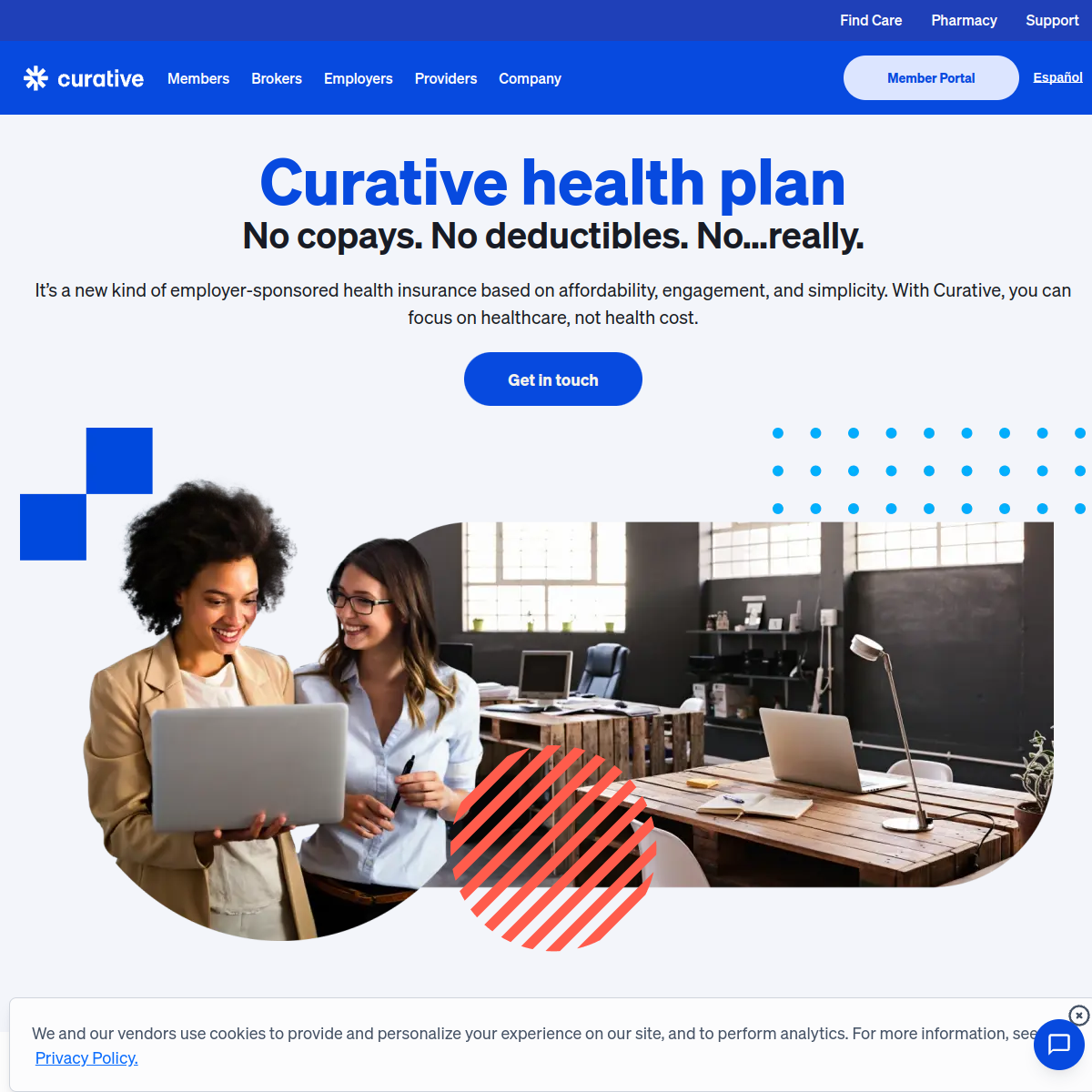
The page we scored
The AI Recommendation Check
When we asked AI who to recommend for employer-sponsored group health insurance plans, it named:
Buyer we put in the prompt: HR Director or Benefits Manager at a company with 50+ employees in FL, GA, MD/DC, or TX. Both the buyer and the category were inferred from Curative’s homepage alone. The model had no web access.
Curative was not on the list.
A buyer who asked AI this question got 8 names and moved on. Curative never came up.
We asked AI who it recommends for "HR Director or Benefits Manager at a company with 50+ employees in FL, GA, MD/DC, or TX" looking for "employer-sponsored group health insurance plans". It named UnitedHealthcare, Blue Cross Blue Shield, Aetna, Cigna, Humana. You did not appear. AI can't recommend what it can't clearly understand.
Overall assessment
Curative's biggest strength is its razor-sharp, instantly repeatable hero claim ... $0 copays, $0 deductibles ... which clears the 7-second test and creates genuine category distinctiveness. The biggest gap is social proof and proof of outcomes: no named customer testimonials, no employer savings data, and no before/after deltas appear on the homepage, leaving the bold promise unsupported by evidence a skeptical buyer can verify.
Signal by category
Narrative Clarity
8 signals
Trust Signal
4 signals
AI Signal
6 signals
Conversion Signal
1 signal
Weakest signal · fix this first
12Alternatives Acknowledged
“No mention of competitors, alternative plans, or 'do nothing' option anywhere on the page.”
The page never acknowledges that buyers could stay with traditional insurance, self-insure, or choose a competitor ... alternatives are completely absent.
All 19 signals, scored 0 to 2.
Total 22/38
Narrative Clarity
8 signals
- 2
01The 7-Second Test
“No copays. No deductibles. No…really.”
Within 7 seconds a stranger understands this is a zero-cost employer health plan; the hook is concrete, memorable, and instantly differentiating.
- 1
02Rebellion / Movement
“It's a new kind of employer-sponsored health insurance based on affordability, engagement, and simplicity.”
There's an implicit enemy (traditional copay/deductible plans), but no named status quo, no named adversary ... the rebellion is implied, not declared.
- 1
03Owned Language & Category
“Curative Cash Card”
The 'Curative Cash Card' and 'Baseline Visit' are proprietary terms, but no overarching named category or owned framework is staked ... the broader claim is just 'new kind of health insurance.'
- 1
04ICP Clarity
“Employer (50+ employees in FL, GA, MD/DC, or TX)”
The contact form reveals the size and geography filter, but the homepage hero doesn't lead with this ICP ... buyers have to scroll to a form to discover they need 50+ employees in specific states.
- 1
05Problem Leadership
“focus on healthcare, not health cost”
The page gestures at the cost-barrier problem but leads with the solution features ($0 copay/deductible) rather than painting the buyer's pain first in their language.
- 2
06Solution Clarity
“$0 copays, $0 deductibles, and only one competitive monthly premium”
Any visitor can repeat exactly what Curative does after reading the hero: employer health insurance with zero copays and deductibles, one monthly premium.
- 1
07Cost of Inaction
“When cost barriers are removed from health insurance, members stop skipping care, and companies stop paying for it later.”
This line hints at the cost of inaction (paying more later) but it's buried below the fold and never quantified with dollars or data.
- 1
08Promised Land
“We help you reach the healthiest version of you.”
The promised land is generic wellness language; a specific 'after' state for the employer buyer (lower premiums, healthier workforce metrics) is never painted concretely.
Trust Signal
4 signals
- 1
09Proof & Evidence
“A- (Excellent) Financial Strength Rating (FSR)... from AM Best for the third consecutive year.”
The AM Best rating is a concrete credential, but there are no before/after cost deltas, no employer savings figures, and no outcome metrics tied to member behavior.
- 1
10Social Proof
“See success stories”
Case studies are linked but not surfaced on the page ... no customer logos, no named testimonials with title/company, no quoted results appear in the scraped homepage content.
- 1
11Authority & Credibility
“A- (Excellent) Financial Strength Rating (FSR) and Long-Term Issuer Credit Rating... from AM Best”
Financial rating is real authority, but there are no founder credentials, original research, named frameworks, or industry recognition beyond internal Comparably awards.
- 0
12Alternatives Acknowledgedweakest
“No mention of competitors, alternative plans, or 'do nothing' option anywhere on the page.”
The page never acknowledges that buyers could stay with traditional insurance, self-insure, or choose a competitor ... alternatives are completely absent.
AI Signal
6 signals
- 1
13Customer Focus
“You'll be excited to engage with Curative and can rest assured that we've got you covered.”
The page mixes customer-facing language with heavy feature/product description; the customer is present but the company's product features dominate the narrative.
- 2
14AI-Parmesan Index
“No AI claims anywhere on the page.”
Curative makes zero AI-powered claims, so there is no AI-parmesan problem ... this scores 2 by absence of the anti-pattern.
- 2
15LLM Quotability
“When cost barriers are removed from health insurance, members stop skipping care, and companies stop paying for it later.”
This declarative causal sentence is clean, quotable, and citation-ready; an LLM could lift it verbatim to explain Curative's thesis.
- 1
16Copyright Freshness
“Read 2025 press release”
A 2025 press release link signals recency, but no visible blog post dates, case study timestamps, or a copyright year appear in the scraped content.
- 2
17Entity Distinctiveness
“$0 copays, $0 deductibles, and only one competitive monthly premium. Think of it like any other monthly subscription.”
The zero-cost-barrier subscription framing is distinctive enough that an AI could not attribute this description to a generic health insurer ... the positioning is unmistakably Curative's.
- 0
18AI Recommendation Check
“AI's picks: UnitedHealthcare, Blue Cross Blue Shield, Aetna, Cigna, Humana, Oscar Health. You were not named.”
We asked AI who it recommends for "HR Director or Benefits Manager at a company with 50+ employees in FL, GA, MD/DC, or TX" looking for "employer-sponsored group health insurance plans". It named UnitedHealthcare, Blue Cross Blue Shield, Aetna, Cigna, Humana. You did not appear. AI can't recommend what it can't clearly understand.
Conversion Signal
1 signal
- 1
19Path & CTA Clarity
“Get in touch”
There is a primary CTA ('Get in touch') and a contact form, but no numbered process explaining what happens after you submit, and no soft secondary CTA working alongside the primary.
Your move
Think Curative’s score is wrong? Good. Let’s look at it together.
Twenty minutes with Greg. Bring the page, bring the argument. You’ll leave knowing exactly which signal is costing Curative the AI recommendation, and what to write instead.
Not on the list? Run your homepage through the free Brand Signal Score and see where you’d land. Same 19 signals, same AI check, two minutes.