
The 2026 Healthtech Messaging Index
Sternum
sternumiot.com·scored September 1, 2026
23/38
Approaching
Close. The bones are good. A few targeted fixes on the weakest signals would push Sternum into magnetic territory.
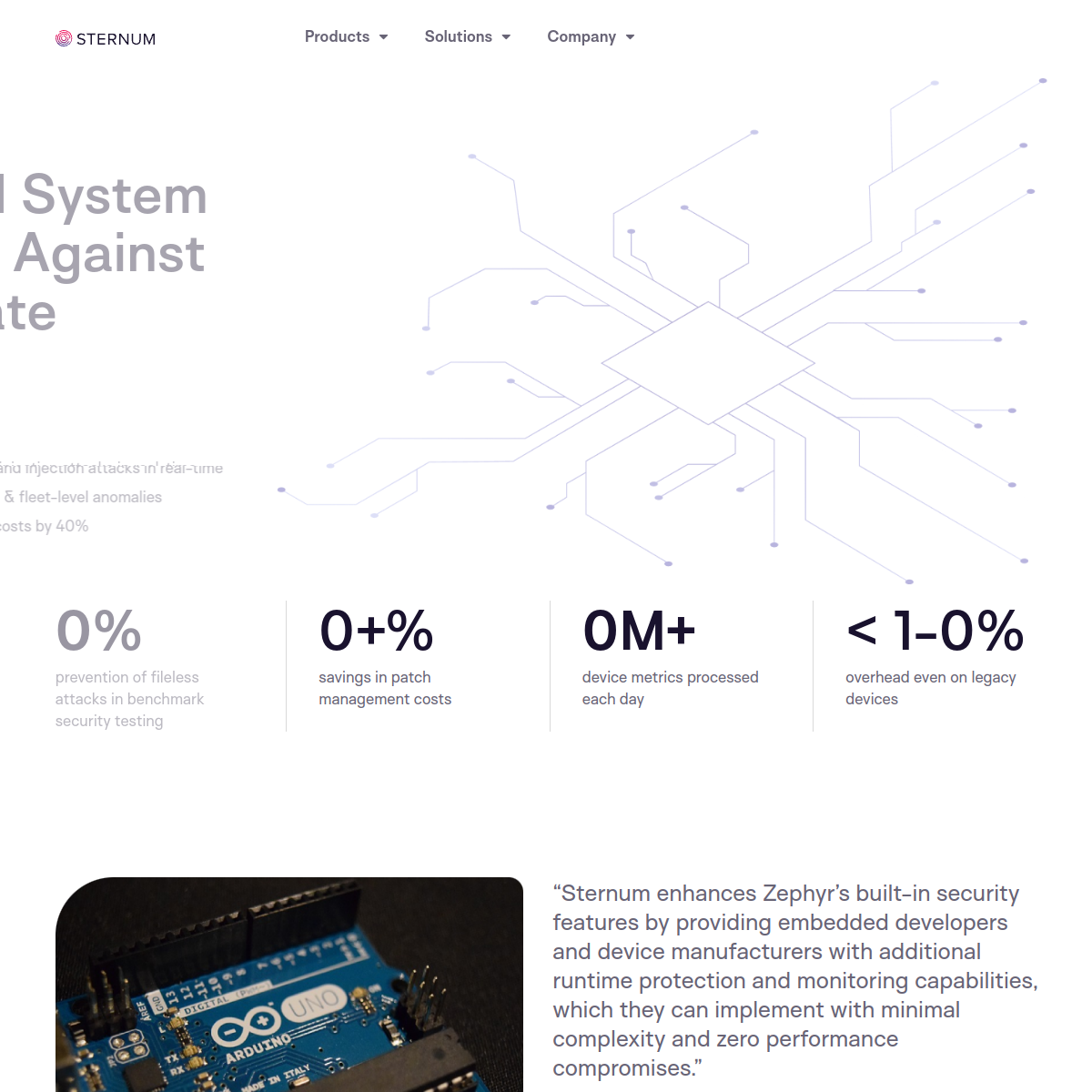
The page we scored
The AI Recommendation Check
When we asked AI who to recommend for Embedded IoT security and observability platform, it named:
Buyer we put in the prompt: CISO, VP of Engineering, or Product Security Director at an IoT or medical device manufacturer. Both the buyer and the category were inferred from Sternum’s homepage alone. The model had no web access.
Sternum was on the list.
AI named them for their own category. That's the signal every homepage is supposed to send.
AI named you when asked who it recommends for "Embedded IoT security and observability platform", and described you accurately: "Sternum provides embedded security and observability for IoT devices using inline binary instrumentation to detect and prevent runtime attacks with low overhead on resource-constrained devices.". Your positioning is landing with the machines.
Overall assessment
Sternum's biggest strength is concrete, credible social proof ... six named testimonials from Medtronic, NXP, Linux Foundation, and Telit, backed by specific benchmark numbers (96.5% prevention, 100M+ daily events), give it unusually strong trust signals for this category. The single biggest gap is the complete absence of CTA architecture and conversion path: there is no primary CTA, no numbered onboarding process, and no acknowledgment of alternatives, meaning a convinced buyer has no clear next step and no contrast frame to close against.
Signal by category
Narrative Clarity
8 signals
Trust Signal
4 signals
AI Signal
6 signals
Conversion Signal
1 signal
Weakest signal · fix this first
12Alternatives Acknowledged
“No mention of competitors, alternative approaches, or 'do nothing' consequences anywhere on the page.”
The page never acknowledges that buyers have other options ... competing tools, manual patching, or inaction ... leaving the buyer without a contrast frame.
All 19 signals, scored 0 to 2.
Total 23/38
Narrative Clarity
8 signals
- 2
01The 7-Second Test
“Embedded System Protection Against Nation State Attacks ... With just 3% overhead…”
The hero immediately tells a technical buyer what is protected (embedded systems), from what (nation-state attacks), and a key differentiator (3% overhead), clearing the 7-second bar.
- 1
02Rebellion / Movement
“Nation State Attacks”
The page implies a rebellion against inadequate embedded security by invoking nation-state-level threats, but never explicitly names a status quo, a competing approach, or an industry pattern it is pushing against.
- 1
03Owned Language & Category
“Patented EIV™ embedded integrity verification software technologies”
EIV™ is a coined, trademarked term with a specific mechanism, but it is buried mid-page in a tab panel and never elevated into a named category or ownable framework an AI would quote in a recommendation.
- 1
04ICP Clarity
“IDS/IPS for Medical Devices”
Medical devices and IoT manufacturers are implied but never explicitly called out by buyer role (e.g., CISO, VP Engineering), company size, or vertical in the hero; the ICP only becomes clearer deep in the page.
- 1
05Problem Leadership
“Embedded System Protection Against Nation State Attacks”
The hero leads with the threat (nation-state attacks) but frames it as a product capability, not in the buyer's problem language ... there is no 'you are struggling with X' statement before the solution pitch.
- 2
06Solution Clarity
“Prevent memory & command injection attacks in real-time, Detect & diagnose device & fleet-level anomalies, Cut patch-management costs by 40%”
A visitor can clearly repeat what Sternum does in one sentence: it protects embedded/IoT devices from runtime attacks while cutting patch costs, with three concrete bullets reinforcing it.
- 1
07Cost of Inaction
“Cut patch-management costs by 40%”
Patch cost reduction hints at the cost of inaction, but the page never explicitly names what happens if the buyer does nothing ... no breach consequences, regulatory fines, or revenue loss are stated.
- 1
08Promised Land
“Make device security and performance tangible for end users”
The 'Innovate' lifecycle section gestures at an after-state, but no vivid, specific promised land scene (e.g., 'ship compliant devices in half the time') is painted anywhere on the page.
Trust Signal
4 signals
- 2
09Proof & Evidence
“96.5% Prevention in benchmark security tests… Up to 60% Savings in patch management costs… 100M+ Events observed every day”
Multiple concrete, specific numbers tied to outcomes are present in the stats bar and reinforced by the NXP quote referencing a head-to-head attack test, clearing the bar for concrete proof.
- 2
10Social Proof
“Kyle Erickson, Former Product Security Director at Medtronic… Marc Vauclair, Senior Security System Architect and Fellow at NXP Semiconductors”
Six named testimonials with full name, title, and company ... including Linux Foundation, Medtronic, NXP, and Telit ... provide strong, credible social proof.
- 1
11Authority & Credibility
“Patented EIV™ embedded integrity verification software technologies”
A patent and a named technology framework demonstrate some authority, but there are no founder credentials, published research, industry awards, or analyst recognition cited on the page.
- 0
12Alternatives Acknowledgedweakest
“No mention of competitors, alternative approaches, or 'do nothing' consequences anywhere on the page.”
The page never acknowledges that buyers have other options ... competing tools, manual patching, or inaction ... leaving the buyer without a contrast frame.
AI Signal
6 signals
- 1
13Customer Focus
“A customer was experiencing issues with unexpected battery depletions, leading to substantial financial losses.”
The customer story vignettes put customers in the spotlight, but the majority of the page describes Sternum's platform features and capabilities, making the company the primary protagonist.
- 1
14AI-Parmesan Index
“AI-Powered Threat Detection… AI-powered predictive analytics… AI-powered automatic alerts”
'AI-powered' appears three times with no mechanistic explanation of how the AI works, making it closer to AI-parmesan sprinkle than substantive AI claims; it scores 1 rather than 0 because the rest of the narrative is strong without depending on AI.
- 1
15LLM Quotability
“All attacks NXP crafted were blocked by Sternum with CPU overhead of less than 3%.”
The NXP quote is clean and citation-ready, but most other page copy is feature-list or marketing prose that an LLM could not lift verbatim as a recommendation-worthy declarative claim.
- 0
16Copyright Freshness
“No visible dates on case studies, blog posts, or a copyright year anywhere in the scraped content.”
Zero date signals are present in the scraped content ... no published dates on customer stories, no copyright year ... which reduces AI recency weighting.
- 2
17Entity Distinctiveness
“Patented EIV™ embedded integrity verification… agentless on-device solution… 96.5% Prevention in benchmark security tests… Nation State Attacks”
The combination of a patented named technology (EIV™), a specific benchmark number (96.5%), the nation-state threat frame, and the agentless constraint makes this positioning distinctly attributable to Sternum and not interchangeable with generic IoT security vendors.
- 2
18AI Recommendation Check
“AI described you as: "Sternum provides embedded security and observability for IoT devices using inline binary instrumentation to detect and prevent runtime attacks with low overhead on resource-constrained devices.”
AI named you when asked who it recommends for "Embedded IoT security and observability platform", and described you accurately: "Sternum provides embedded security and observability for IoT devices using inline binary instrumentation to detect and prevent runtime attacks with low overhead on resource-constrained devices.". Your positioning is landing with the machines.
Conversion Signal
1 signal
- 1
19Path & CTA Clarity
“Learn More… Read the full case study”
There are secondary CTAs (Learn More, case study links) but no single dominant primary CTA, no numbered process showing how to get started, and no soft secondary offer (e.g., free trial vs. demo) clearly differentiated ... process and CTA hierarchy are both missing.
Keep the lead
AI already names Sternum. The next edition decides if it still does.
Twenty minutes with Greg. Bring the page, bring the argument. You’ll leave knowing exactly which signal is costing Sternum the AI recommendation, and what to write instead.
Not on the list? Run your homepage through the free Brand Signal Score and see where you’d land. Same 19 signals, same AI check, two minutes.