
The 2026 Healthtech Messaging Index
VirtuSense Technologies
virtusense.ai·scored September 1, 2026
21/38
Invisible
The page is doing some work, but the story isn't landing fast enough. Buyers and AI are both left guessing what makes VirtuSense Technologies different.
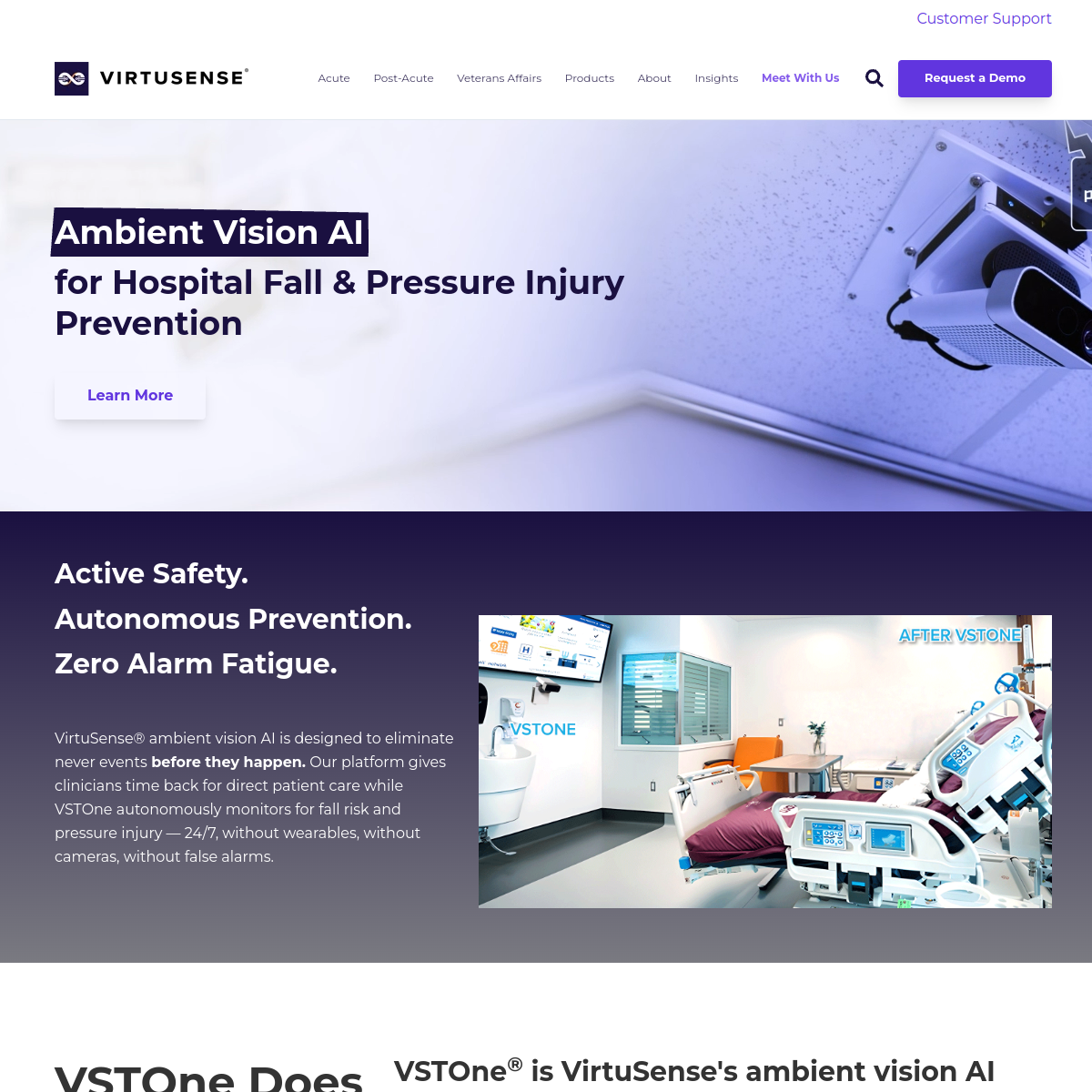
The page we scored
The AI Recommendation Check
When we asked AI who to recommend for ambient AI patient monitoring for hospital fall and pressure injury prevention, it named:
Buyer we put in the prompt: CNO, VP of Patient Safety, or Clinical Informatics leader at an acute care hospital or health system. Both the buyer and the category were inferred from VirtuSense Technologies’s homepage alone. The model had no web access.
VirtuSense Technologies was on the list.
AI named them for their own category. That's the signal every homepage is supposed to send.
AI mentioned you for "ambient AI patient monitoring for hospital fall and pressure injury prevention", but only generically: "VirtuSense is an AI-based patient monitoring company that uses LiDAR or depth-sensing technology to detect fall risk and patient movement in hospital rooms without cameras or wearables.". You're on the radar, but AI doesn't yet repeat your specific positioning back.
Overall assessment
VirtuSense's biggest strength is its mechanistically specific product narrative ... LiDAR sensor, 99.99% accuracy, 98% fewer false alarms, Epic integration, and coined terms like 'Ambient Vision AI' and 'Zero Alarm Fatigue' make it genuinely distinctive and AI-quotable. The biggest gap is the complete absence of customer voice: no named testimonials, no case study outcomes with real numbers, blank impact metric placeholders, and zero recency signals mean the page cannot build trust beyond logo recognition, and a serious buyer has no proof of transformation to justify a purchase decision.
Signal by category
Narrative Clarity
8 signals
Trust Signal
4 signals
AI Signal
6 signals
Conversion Signal
1 signal
Weakest signal · fix this first
11Authority & Credibility
“No founder credentials, original research, awards, frameworks, or named authority figures anywhere on the page.”
Authority is entirely absent ... no named founders, no published research, no awards cited, and no external validators beyond client logos.
All 19 signals, scored 0 to 2.
Total 21/38
Narrative Clarity
8 signals
- 2
01The 7-Second Test
“Ambient Vision AI for Hospital Fall & Pressure Injury Prevention”
The hero instantly communicates who it's for (hospitals), what it solves (falls and pressure injuries), and the mechanism (ambient vision AI) ... a stranger gets it in under 7 seconds.
- 1
02Rebellion / Movement
“without wearables, without cameras, without false alarms”
There's an implicit rebellion against legacy bed/chair pads and wearables, but no named enemy, no labeled status quo, and no manifesto-level point of view staking out a movement.
- 2
03Owned Language & Category
“Ambient Vision AI" ... "Active Safety. Autonomous Prevention. Zero Alarm Fatigue.”
VirtuSense owns 'Ambient Vision AI,' 'Active Safety AI,' and 'Zero Alarm Fatigue' as coined terms ... distinct enough that an AI could quote and attribute them to this company specifically.
- 1
04ICP Clarity
“VSTOne® is VirtuSense's ambient vision AI platform for acute care”
Acute care hospitals are implied but buyer role (CNO, VP of Patient Safety, etc.), health system size, and decision-maker title are never named, leaving ICP only partially visible.
- 1
05Problem Leadership
“designed to eliminate never events before they happen”
The problem (never events, falls, pressure injuries) is named but the page leads with the product and its features rather than dwelling in the buyer's pain before pivoting to the solution.
- 2
06Solution Clarity
“One device. Eight use cases. Fully integrated with Epic.”
A visitor can repeat exactly what VSTOne does ... one LiDAR sensor per room that autonomously monitors for falls and pressure injuries across eight use cases with Epic integration.
- 1
07Cost of Inaction
“98% fewer false alarms than traditional bed and chair pads”
The cost of the status quo is implied through false alarm rates and never events, but the page never names the financial, regulatory, or reputational price a hospital pays for not acting.
- 1
08Promised Land
“gives clinicians time back for direct patient care”
The promised land is gestured at ... clinicians freed up, fewer never events ... but there is no vivid, specific 'after' state describing what a hospital actually looks and feels like post-deployment.
Trust Signal
4 signals
- 1
09Proof & Evidence
“99.99% accuracy rate" and "98% fewer false alarms than traditional bed and chair pads”
Two concrete numbers exist, which is good, but the impact section's key metrics (Falls Prevented, Costs Saved) appear as blank placeholders with no actual values rendered on the page.
- 1
10Social Proof
“Cleveland Clinic, NYU Langone Health, UNC logo visible in client list”
Recognizable logos including Cleveland Clinic and NYU Langone add real credibility, but there are zero named testimonials, quotes, titles, or case study stories anywhere on the page.
- 0
11Authority & Credibilityweakest
“No founder credentials, original research, awards, frameworks, or named authority figures anywhere on the page.”
Authority is entirely absent ... no named founders, no published research, no awards cited, and no external validators beyond client logos.
- 0
12Alternatives Acknowledged
“No mention of competitors, alternative solutions, or 'do nothing' cost anywhere on the page.”
The page never acknowledges that buyers have other options including doing nothing, making it impossible to trust that VirtuSense has honestly reckoned with the competitive landscape.
AI Signal
6 signals
- 1
13Customer Focus
“gives clinicians time back for direct patient care”
The page tilts toward product capabilities and feature lists rather than telling a customer transformation story ... the company and its device are the protagonist, not the clinician or patient.
- 2
14AI-Parmesan Index
“deploys a single LiDAR-based sensor per room to autonomously monitor patients”
The AI claims are mechanistically grounded ... LiDAR sensor, 99.99% accuracy, 98% fewer false alarms ... not vague 'AI-powered' sprinkle, earning a clean score.
- 1
15LLM Quotability
“VSTOne autonomously monitors patients with a 99.99% accuracy rate ... and 98% fewer false alarms than traditional bed and chair pads.”
This sentence is close to quotable but the blank metric placeholders in the impact section undermine the page's overall quotability for an LLM building a recommendation.
- 0
16Copyright Freshness
“No visible dates on blog posts, case studies, or news; copyright year not visible in scraped content.”
There are zero recency signals ... no dated content, no copyright year rendered ... which is a direct negative signal for AI engines that weight freshness.
- 2
17Entity Distinctiveness
“single LiDAR-based sensor per room" ... "Zero Alarm Fatigue" ... "One device. Eight use cases. Fully integrated with Epic.”
The LiDAR-based ambient vision approach with zero alarm fatigue positioning, Epic deep integration, and coined terminology makes this company meaningfully distinguishable from generic patient monitoring competitors.
- 1
18AI Recommendation Check
“AI named you alongside Viz.ai, Bodily, Sentry, VirtuSense, Brainomix, describing you as: "VirtuSense is an AI-based patient monitoring company that uses LiDAR or depth-sensing technology to detect fall risk and patient movement in hospital rooms without cameras or wearables.".”
AI mentioned you for "ambient AI patient monitoring for hospital fall and pressure injury prevention", but only generically: "VirtuSense is an AI-based patient monitoring company that uses LiDAR or depth-sensing technology to detect fall risk and patient movement in hospital rooms without cameras or wearables.". You're on the radar, but AI doesn't yet repeat your specific positioning back.
Conversion Signal
1 signal
- 1
19Path & CTA Clarity
“Request a Demo" CTA present; no numbered process or soft secondary CTA visible on page.”
There is one clear primary CTA but no visible step-by-step path explaining what happens next and no soft secondary option (e.g., download a case study), so the conversion path is incomplete.
Keep the lead
AI already names VirtuSense Technologies. The next edition decides if it still does.
Twenty minutes with Greg. Bring the page, bring the argument. You’ll leave knowing exactly which signal is costing VirtuSense Technologies the AI recommendation, and what to write instead.
Not on the list? Run your homepage through the free Brand Signal Score and see where you’d land. Same 19 signals, same AI check, two minutes.